

The Arms Trade is Big Business
Author and Page information
- This page: https://www.globalissues.org/article/74/the-arms-trade-is-big-business.
- To print all information (e.g. expanded side notes, shows alternative links), use the print version:
The world spends some $1,000 billion annually on the military. How is this so?
On this page:
World Military Spending Out Does Anything Else
As detailed further on the next page on military expenditure, world military spending has now reached one trillion dollars, close to Cold War levels.
As summarized from the Military Balance, 2000/2001, by the International Institute for Strategic Studies (October 2001), for the larger arms-purchasing nations each year:
- Arms procurement is normally 20-30% of their military budgets
- The main portion is usually on operations, maintenance and personnel
- Some 40 to 50 billion dollars are in actual deliveries, (that is, the delivery of sales, which can be many years after the initial contract is signed)
- Each year, around 30-35 billion dollars are made in actual sales (agreements, or signing of contracts).
In more recent years, annual sales of arms have risen to around $50-60 billion although the global financial crisis is slowly beginning to be felt in arms sales too.
Arms sales figures
Every year, the U.S. Congressional Research Service releases an authoritative report looking at arms transfers to the developing world.
The latest report (as of writing), released August 24, 2012, is titled Conventional Arms Transfers to Developing Nations, 2003-2011 .
These reports are also known as the Grimmett Report, after the author, Richard F. Grimmett. They provide insight into where the arms are going. The following breakdowns are based on this report.
Global Arms Sales By Supplier Nations
The 5 UN Security Council permanent members are generally the largest arms dealers (though others such as Germany often feature quite high - higher than China for example):
| Supplier | Total Sales in US Dollars (billions) | Percent of total sales |
|---|---|---|
Source: Richard F. Grimmett, CRS Report for Congress; Conventional Arms Transfers to Developing Nations, 2004-2011 , August 24, 2012 Notes: Percentages are rounded; Each country shown as follows:
If you are viewing this table on another site, please see https://www.globalissues.org/article/74/the-arms-trade-is-big-business for further details and context. | ||
| United States | 220.608 | 44% |
| Russia | 83.323 | 17% |
| France | 41.96 | 8% |
| United Kingdom | 27.037 | 5% |
| China | 17.808 | 4% |
| Germany | 22.068 | 4% |
| Italy | 14.278 | 3% |
| Other European | 48.259 | 10% |
| Others | 27.109 | 5% |
Global Arms Sales Trends 2004-2011
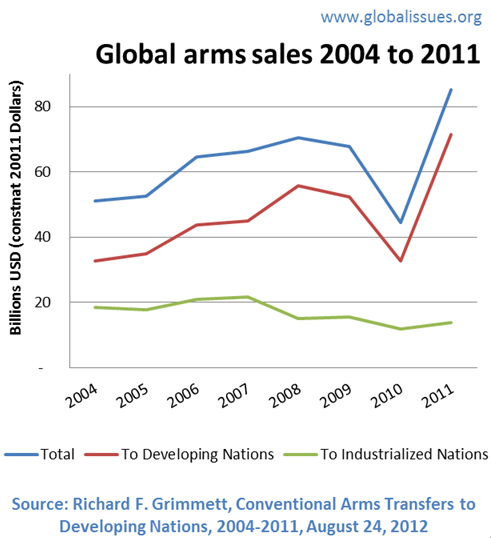
Developing countries are the main recipients of arms sales:
As a chart
Raw data
| Year | Total Dollars | Percentage of total |
|---|---|---|
Source: Richard F. Grimmett, CRS Report for Congress; Conventional Arms Transfers to Developing Nations, 2004-2011 , August 24, 2012 Notes: Percentages are rounded; Each country shown as follows:
If you are viewing this table on another site, please see https://www.globalissues.org/article/74/the-arms-trade-is-big-business for further details and context. | ||
| 2004 | 51.054 | 10% |
| 2005 | 52.538 | 10% |
| 2006 | 64.505 | 13% |
| 2007 | 66.338 | 13% |
| 2008 | 70.567 | 14% |
| 2009 | 67.765 | 13% |
| 2010 | 44.508 | 9% |
| 2011 | 85.274 | 17% |
Developing nations are top recipients
The Grimmett Report also notes that,
- Developing nations continue to be the primary focus of foreign arms sales activity by weapons suppliers though most arms are supplied by just 2 or 3 major suppliers.
- Despite the global economic climate, major purchases continue to be made by a select few developing nations in these regions, principally India in Asia, and Saudi Arabia in the Middle East.
- Saudi Arabia and India’s large spending reflects their modernization efforts since the 1990s.
- The strength of individual economies of a wide range of nations in the developing world continues to be a significant factor in the timing of many of their arms purchasing decisions.
- Increases in the price of oil, while an advantage for major oil producing states in funding their arms purchases, has, simultaneously, caused economic difficulties for many oil consuming states, contributing to their decisions to curtail or defer new weapons acquisitions.
- A number of less affluent developing nations have chosen to upgrade while reducing new purchases.
For arms suppliers, despite the impact the global economic situation has had recently on sales, a number of weapons-exporting nations have increased competition for sales, going into areas and regions they may not have previously been prominent. Competition between sellers will only intensify due to the limits for growth, Grimmet also notes.
Although recent years were showing a sign of declining sales, 2011 saw a massive jump, almost solely by what the report describes as an extraordinary
increase in market share by the US, whose massive sales to Saudi Arabia distorted an otherwise downward trend in arms sales.
Many Middle East countries purchase arms from the US which became the prime supplier to the region after the 1991 Persian Gulf crisis, the report notes. In more recent years, concerns (real or exaggerated) over Iran have contributed to further purchases in addition to military modernization programs.
Just ten developing nation recipients of arms sales accounted for 61% of the total developing nations arms market between 2004 and 2011:
| Rank | Country | Amount spent | Percent of total |
|---|---|---|---|
Source: Richard F. Grimmett, CRS Report for Congress; Conventional Arms Transfers to Developing Nations, 2004-2011 , August 24, 2012 Note: Percentages are approximate. If you are viewing this table on another site, please see https://www.globalissues.org/article/74/the-arms-trade-is-big-business for further details and context. | |||
| 1 | Saudi Arabia | 75.7 | 21% |
| 2 | India | 46.6 | 13% |
| 3 | UAE | 20.3 | 6% |
| 4 | Egypt | 14.3 | 4% |
| 5 | Pakistan | 13.2 | 4% |
| 6 | Venezuela | 13.1 | 4% |
| 7 | Brazil | 10.9 | 3% |
| 8 | Algeria | 10.3 | 3% |
| 9 | Israel | 9.5 | 3% |
| 10 | South Korea | 9.2 | 2% |
| 11 | All other developing countries | 145.168 | 39% |
What is sold?
The Grimmett Report describes items counted in the weapons categories as follows:
- Tanks and Self-propelled Guns:
- This category includes light, medium, and heavy tanks; self-propelled artillery; self-propelled assault guns.
- Artillery:
- This category includes field and air defense artillery, mortars, rocket launchers and recoilless rifles — 100 mm and over; FROG launchers — 100mm and over.
- Armored Personnel Carriers (APCs) and Armored Cars:
- This category includes personnel carriers, armored and amphibious; armored infantry fighting vehicles; armored reconnaissance and command vehicles.
- Major Surface Combatants:
- This category includes aircraft carriers, cruisers, destroyers, frigates.
- Minor Surface Combatants:
- This category includes minesweepers, subchasers, motor torpedo boats, patrol craft, motor gunboats.
- Submarines:
- This category includes all submarines, including midget submarines.
- Guided Missile Patrol Boats:
- This category includes all boats in this class.
- Supersonic Combat Aircraft:
- This category includes all fighter and bomber aircraft designed to function operationally at speeds above Mach 1.
- Subsonic Combat Aircraft:
- This category includes all fighter and bomber aircraft designed to function operationally at speeds below Mach 1.
- Other Aircraft:
- This category includes all other fixed-wing aircraft, including trainers, transports, reconnaissance aircraft, and communications/utility aircraft.
- Helicopters:
- This category includes all helicopters, including combat and transport.
- Surface-to-air Missiles:
- This category includes all ground-based air defense missiles.
- Surface-to-surface Missiles:
- This category includes all surface-surface missiles without regard to range, such as Scuds and CSS-2s. It excludes all anti-tank missiles. It also excludes all anti-ship missiles, which are counted in a separate listing.
- Anti-ship Missiles:
- This category includes all missiles in this class such as the Harpoon, Silkworm, Styx and Exocet.
As world trade globalizes, so does the trade in arms
Control Arms is a campaign jointly run by Amnesty International, International Action Network on Small Arms (IANSA) and Oxfam. In a detailed report titled, Shattered Lives, they highlight that arms are fueling poverty and suffering, and is also out of control. In addition,
The lack of arms controls allows some to profit from the misery of others.
- While international attention is focused on the need to control weapons of mass destruction, the trade in conventional weapons continues to operate in a legal and moral vacuum.
- More and more countries are starting to produce small arms, many with little ability or will to regulate their use.
- Permanent UN Security Council members—the USA, UK, France, Russia, and China—dominate the world trade in arms.
- Most national arms controls are riddled with loopholes or barely enforced.
- Key weaknesses are lax controls on the brokering, licensed production, and 'end use' of arms.
- Arms get into the wrong hands through weak controls on firearm ownership, weapons management, and misuse by authorised users of weapons.
The top five countries profiting from the arms trade are the five permanent members of the United Nations Security Council: the USA, UK, France, Russia, and China.
From 1998 to 2001, the USA, the UK, and France earned more income from arms sales to developing countries than they gave in aid.
The arms industry is unlike any other. It operates without regulation. It suffers from widespread corruption and bribes. And it makes its profits on the back of machines designed to kill and maim human beings.
So who profits most from this murderous trade? The five permanent members of the UN Security Council—the USA, UK, France, Russia, and China. Together, they are responsible for eighty eight per cent of reported conventional arms exports.
We can’t have it both ways. We can’t be both the world’s leading champion of peace and the world’s leading supplier of arms.Former US President Jimmy Carter, presidential campaign, 1976
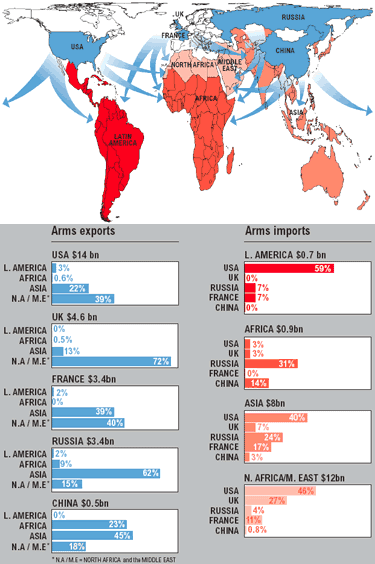
The third world is often the destination for arms sales as the Control Arms Campaign also highlights graphically:
In order to make up for a lack of sales from domestic and traditional markets for military equipment, newer markets are being created or sought after. This is vital for the arms corporations and contractors in order to stay afloat.
Respect for human rights is often overlooked as arms are sold to known human rights violators.
Heavy militarization of a region increases the risk of oppression on local people. Consequently reactions and uprisings from those oppressed may also be violent. The Middle East is a current example, while Latin America is an example from previous decades, where in both cases, democracies or popular regimes have (or had) been overthrown with foreign assistance, and replaced with corrupt dictators or monarchs. Oppression (often violent) and authoritarianism rule has resulted. Sometimes this also itself results in terrorist reactions that lash out at other innocent people.
A deeper cycle of violence results. The arms trade may not always be a root cause, because there are often various geopolitical interests etc. However, the sale of arms can be a significant contributor to problems because of the enormous impact of the weapons involved. Furthermore, some oppressive regimes are only too willing purchase more arms under the pretext of their own war against terrorism.
In quoting a major international body, six basic points harshly criticizing the practices and impacts of the arms industry are listed below, by J.W. Smith:
- That the armament firms have been active in fomenting war scares and in persuading their countries to adopt warlike policies and to increase their armaments.
- That armament firms have attempted to bribe government officials, both at home and abroad.
- That armament firms have disseminated false reports concerning the military and naval programs of various countries, in order to stimulate armament expenditure.
- That armament firms have sought to influence public opinion through the control of newspapers in their own and foreign countries.
- That armament firms have organized international armament rings through which the armament race has been accentuated by playing off one country against another.
- That armament firms have organized international armament trusts which have increased the price of armaments sold to governments.
But, this was not of the arms industry of today. Smith was quoting the League of Nations after World War I, when Stung by the horrors of World War I, world leaders realized that arms merchants had a hand in creating both the climate of fear and the resulting disaster itself.
. And unfortunately, it also summarizes some of the problems of today, too. Justification for arms and creating the market for arms expenditure is not a new concept. The call to war and fear-mongering is an old tradition.
This rush to globalize arms production and sales ignores the grave humanitarian and strategic consequences of global weapons proliferation. Already, profit motives in the military industry have resulted in arms export decisions that contravene such U.S. foreign policy goals as preserving stability and promoting human rights and democracy.
Hidden Corporate Welfare?
Industrialized countries negotiate free trade and investment agreements with other countries, but exempt military spending from the liberalizing demands of the agreement. Since only the wealthy countries can afford to devote billions on military spending, they will always be able to give their corporations hidden subsidies through defence contracts, and maintain a technologically advanced industrial capacity.
And so, in every international trade and investment agreement one will find a clause which exempts government programs and policies deemed vital for national security. Here is the loophole that allows the maintenance of corporate subsidies through virtually unlimited military spending.
Vast government subsidies are sought after in the pursuit of arms trading.
US and European corporations receive enormous tax breaks and even lend money to other countries to purchase weapons from them. Therefore tax payers from these countries end up often unknowingly subsidizing arms sales.
While there are countless examples, a recent one that made a few news headlines was how Lockheed managed to get US subsidies to help sell a lot of fighter planes to Poland at the end of 2002/beginning of 2003. This was described as the biggest deal ever in Europe at that time.
Arms Trade Post September 11, 2001
To counter the horrific act of terrorism in the United States, on September 11, 2001, George Bush has started a War on Terrorism. However, Human Rights Watch has argued that in the pursuit of military policies which include selling arms or providing assistance to other countries, the U.S. has expressed minimal concern about the potential side effects
. That is, the increase in militarism itself is risking both the restriction of people’s rights, and the entrenching of power of those who violate human rights.
See also Post Sept. 11 Arms Sales and Military Aid Demonstrate Dangerous Trend from the Washington D.C.-based Center for Defense Information. They list a compilation of post-Sept. 11 pending and approved U.S. arms sales. One concerning trend that the Center raises is that The United States is more willing than ever to sell or give away weapons to countries that have pledged assistance in the global war on terror.
And in order to do this the United States has revised the list of countries that are ineligible to receive U.S. weapons so that a significant number of countries … are now receiving military aid that would have been denied before Sept. 11.
Side NotePending and approved sales from other countries are not listed. If such information is known, please let me know, so it can be listed here as well.
In addition, the Federation of American Scientists also raise the issue that U.S. military aid has been justified around the world on the grounds of the war on terror, even though that has at times been a dubious reason. In addition, previous restrictions or conditions for military aid are being jettisoned
:
The relentless assault on [U.S.] military aid restrictions that began shortly after the September 11th attacks … has continued unabated. This spring the [Bush] administration attempted yet again to win blanket exemptions for aid distributed as part of the
war on terrorby including language in the FY2002 supplemental appropriations bill that waives most existing restrictions and reporting requirements. The administration’s second attempt was more successful. Two key Defense Department funding allocations—$390 million to reimburse nations providing support to U.S. operations in the war on terror and $120 millionfor certain classified activities—can now be deliverednotwithstanding any other provision of the law.This means there will be none of the normal restrictions placed on this large sum of military aid.The provision on
classified activitiesis especially troubling because it permitsprojects not otherwise authorized by law,in other words, covert actions. Not only is the language in the Supplemental opaque, attempts to get more information from a defense committee staffer led nowhere. He refused to answer questions about the intended use of the funds, the applicability of foreign aid restrictions, and reporting requirements on the grounds that all of that information isclassified.In other words, there will be no public scrutiny of this aid, and that’s just fine with Congress.The Bush administration may also be successful in its campaign to ease restrictions on military aid and training to Indonesia despite that country’s utter failure to improve its military’s human rights practices. In May, Defense Secretary Donald Rumsfeld proclaimed that it is
time for [the restrictions] to be adjusted substantially.If the results of the Senate Appropriations committee mark up are any indicator, Mr. Rumsfeld is likely to get his wish.… This latest round of military aid has made one thing clear: the U.S. military has found a new excuse to extend its reach around the globe, arming regimes that had previously been blacklisted for human rights abuses, weapons proliferation, or brutal conflict. What remains to be seen is how long Congress and the American public will accept this formula, especially when they see no concrete results in return.
Furthermore, Lip Magazine highlights that the U.S. has sold weapons or training to almost 90% of the countries it has identified as harboring terrorists.
It does not seem to matter who arms are sold to
Last year [2000] the U.S. controlled half of the developing world’s arms market…. This dominance of the global arms market is not something in which the American public or policy makers should take pride in. The U.S. routinely sells weapons to undemocratic regimes and gross human rights abusers.
As mentioned above, the War on Terror
has seen the U.S. selling weapons or training to almost 90% of the countries it has identified as harboring terrorists. Yet, for decades, a lot of the arms that the West has sold has gone into the hands of military dictatorships or corrupt governments. This can have the additional intention or effect of hampering any form of democracy in those countries.
Sometimes, these arms sales are made secretly and sometimes, arms are sold to human rights violators (such as one third of all sales by the US, in 1998, as the previous link notes).
According to a report, from the Council for a Livable World’s Arms Trade Oversight Project, [s]ince the end of the Cold War, the United States has been the world’s largest arms dealer … Consequently, governments with some of the worst human rights records [have] received American weapons and training.
In November 2001, The Center for Defense Information, a military watch-dog in Washington D.C., provided a detailed list of the 18 countries and 28 terrorist groups cited by the U.S. State Department as hotbeds of terrorist activity. Included in the list is a chronology of U.S. arms sales and training from 1990-1999 and information on use of child soldiers by governments and non-state actors in each country. The U.S. supplied arms to a number of these nations:
In the period of 1990-1999, the United States supplied 16 of the 18 countries on the [U.S.] State Department list with arms through the government-to-government sales under the Foreign Military Sales (FMS) program, or through industry contracted Direct Commercial Sales (DCS) programs, or with military assistance. Recipients included Algeria, Iraq, Lebanon, and Sri Lanka …, where, arguably, the risk of diversion is high. In addition, the U.S. military (and the CIA) has trained the forces of many of these 18 countries in U.S. war fighting tactics, in some cases including individuals now involved in terrorism.
A report from the World Policy Institute released mid-2005 has found that the U.S. is routinely funneling military aid and arms to undemocratic nations. In 2003, for which the most recent data was available at the time,
- The United States transferred weaponry to 18 of the 25 countries involved in active conflicts;
- More than half of the top 25 recipients of U.S. arms transfers in the developing world (13) were defined as undemocratic by the State Department;
- When countries designated by the State Department’s Human Rights Report to have poor human rights records or serious patterns of abuse are factored in, 20 of the top 25 U.S. arms clients in the developing world in 2003—a full 80%—were either undemocratic regimes or governments with records of major human rights abuses.
The arms trade is corrupt
As noted in this site’s section on the arms trade code of conduct, many nations are often against measures to improve transparency of international arms.
Part of that reason might be the benefits involved. The international arms trade is also considered to be one of the three most corrupt businesses in the world, according to Transparency International, the leading global organization monitoring corruption.
Professor Robert Neild of Cambridge University writes extensively about corruption, and notes the following with regards to the arms trade:
The Cold War arms race enhanced the opportunities for corruption in the arms trade…. It is not just the buccaneering arms salesmen of the USA or the méchant French who have resorted to bribery. The leading arms firms in virtually every major arms-producing country have been implicated, including reputable firms from most respectable countries…. Nor have bribes been paid only to buyers in the Third World….
Neild notes how some of the top most people in rich countries, from ministers, to even a prince, have been implicated in such corruption. The end of the Cold War, Neild also observes, has not led to a let up of corruption in the arms trade:
Bribery in the arms trade has not subsided since the end of the Cold War. On the contrary, as military spending has been cut back the arms firms have been seeking markets abroad more fiercely than before…. One recent estimate reckons that in the international arms trade
roughly $2.5 billion a year is paid in bribes, nearly a tenth of turnover.…
[With regards to corruption,] the relevant feature of arms trade is that … government ministers, civil servants and military officers have become so intimately involved in the arms export business that they must have been unable to avoid condoning bribery (for example, by turning a blind eye to it), if not encouraging it (for example, by providing advice when serving in embassies overseas about which members of the local hierarchy it was best to approach and how); or obtaining funds from it for the benefit of themselves, or in the case of politicians, for their political party.
The OECD Convention and the new English law against bribing foreigners are steps in the right direction, but its success will depend on how far the exporting countries, led by the United States, manage jointly and sincerely to enforce restraint and deal with such problems as the payment of bribes through foreign subsidiaries. Part of the arms trade is as elusive and rotten as the drugs trade.
Geopolitical and Economic Agendas
With the arms trade, governments and corporations can cooperate
to meet their different political and economic agendas. The military industrial complexes of the powerful countries also help influence and shape foreign and military policies in a way that enhances their bottom line of profits. For governments though, selling arms can help other geopolitical and strategic interests. Consider, for example, the following:
- A number of years ago, the United States had agreed to sell 80 advanced F16s to the United Arab Emirates. The deal was estimated to be around $15 billion. In return, the US was to be able to build military bases there with improved access to the only deep-water port capable of housing carriers in the Persian Gulf. This led to concerns about the resulting stability in the region and the possibility of an arms race this could start with neighbors. It is of course hard to know if subsequent arms purchases in the region has been precisely because of this.
- Many US weapons are also sold to Turkey. These have been used against the Kurds, in what some have described as the worst human rights violations and ethnic cleansing since the second World War. The US turns a blind eye to these atrocities because they are able to set up bases in such a key geopolitical location, giving access to places in the Middle East, and because Turkey could be one of the main receivers of oil headed to Western countries, from the Caspian sea.
- There are also many arms trade-related interests in the Middle East. By having pro-US monarchies and other regimes (not necessarily democracies) at the helm and promoting policies that often ignore democracy and human rights, arms deals are often lucrative and help continue US foreign policy objectives.
- The British arms manufacturer, BAE was being investigated for bribing Saudi officials to buy fighter planes, but the government intervened in the investigation citing national interests. The Guardian also reported that BAE gave a Saudi prince a £75 airliner ($150m approx) as part of a British arms deal, with the arms firm paying the expenses of flying it. This seemingly large figure is small compared to the overall deal, but very enticing for the deal makers, and it is easy to see how corruption is so possible when large sums are involved.
- Furthermore, the Middle East is the most militarized region in the world procuring more arms than anywhere else. When combining authoritarian regimes and dictatorships, with arms sellers willing to sell weapons to those regimes, the people of the regions are often repressed, and this is a partial (not the only) explanation for why there is so much fanaticism and extremism. (That is, severe and extreme measures in governance and religion, etc has resulted in counter reactions that are also extremist. The majority of ordinary people that want neither of these extremities are the ones that pay the real price.)
- The New York Times noted that China has been suspected of flouting international sanctions and selling arms to countries such as Libya, DRC, Sudan and others that are involved in conflicts. China of course denies most of this but the article notes that internal problems and tension between various factions such as the Defense Ministry and the Foreign Ministry as both have a say in approving arms sales and that state-run military companies (a so-called government-military-industrial complex) has an advantage over foreign ministry.
- Inter Press Service notes concerns from various human rights groups as the US continued with a partial sale arms to Bahrain even though Bahrain’s violent suppression of protesters as part of the Arab Spring has been well known.
As mentioned later in this web site’s section on arms trade, selling advanced weapons is often accompanied by the same sellers and the military industrial complex pointing out how the new world is getting more dangerous due to an increase in the sophistication of weapons. As a result, they inevitably recommend more research and development to stay ahead! This is a nice circular argument that also serves to keep the military industry in business, largely paid for by the tax payers. The Council for a Livable World’s Arms Trade project shows an example of this, in an article, where the title alone summarizes this situation quite well: U.S. in arms race with itself. The article describes how the U.S. Pentagon allows the U.S. Navy to export its newest jets. As a result, they note that:
A pattern is developing wherein U.S. weapons exports and new weapons procurement are driving each other.
- After, and occasionally even before, new weapons roll off the assembly line, they are offered to foreign customers.
- Each overseas sale of top-line U.S. combat equipment represents an incremental decrease in U.S. military superiority.
- This gradual decline in military strength spurs politicians, the military and the defense industry to press for higher military spending to procure increasingly sophisticated equipment superior to weapons shipped overseas.
- This latest technology is again offered to foreign customers, and the cycle begins anew.
As another example, consider India. Since September 11, 2001, there has been even more volatility in terms of Muslim/Hindu relations, India/Pakistan/Kashmir tensions and other issues. As a result, India is seeking to increase their military spending, while arms dealers are only too willing to help both India and Pakistan. Furthermore, government officials from major arms dealing nations are major actors in attempting to see deals through, as there are obvious political dimensions.
The Financial Times in UK reported (February 27, 2002), that While the international community calls for restraint on the Indo-Pakistan border, governments led by the UK and the US are jockeying as never before for a bigger slice of India’s growing arms budget.
Further, they also reported that, Industry officials were unabashed in admitting that the current regional tension between the nuclear-armed neighbors is a unique selling opportunity.
(Emphasis Added).
One could point out that as a business an arms company’s main objective is to make profit so they can remain in business. However, for governments that host these arms industries, it would seem that security issues would be an important part of their foreign policy objective.
In that context then, when even very senior government officials are taking part in procuring contracts, it suggests that while this helps achieve economic objectives of arms firms, it doesn’t really address the issue of achieving political stability or not, or even if it is really a major concern as touted. For sure, it is no easy task for such governments because there can be powerful domestic interests and issues and concerns from related industry and other groups, who can argue that continuing to sell arms will help maintain or even create jobs, etc. (This is discussed in more detail a bit later in this section on propaganda for arms trade).
For example, in reference to India holding so-called talks with various governments on easing India-Pakistan tensions (while pitching for defense contracts), the same Financial Times report also points out that Jack Straw, Britain’s Foreign Secretary, is also expected to use the opportunity to lobby for a Pounds 1bn (Euros 1.6bn, Dollars 1.43bn) deal to sell BAE Systems Hawk jets to India
. An official of no less stature than Foreign Secretary (somewhat similar to U.S. Secretary of State) is involved in marketing
for a weapons company.
But it can go even higher than that. Yahoo world news quoted (February 22, 2002), Praful Bidwai, an Indian journalist and commentator who specializes on defense issues who commented on British Prime Minister, Tony Blair, It’s disgraceful that Blair should have spent more than half his time in India [during his last visit] urging India to buy the jets.
(The sale of jets Bidwai is referring to is 66 British-made hawk jets, at a cost equivalent to US$1.4 billion.)
While public relations departments of such governments can say that their leaders are going on humanitarian or peace missions to urge some nations not to go to war, they are also selling arms at the same time, often to both parties. Geopolitically, this is divide and conquer
still at work, while economically, this proves beneficial to the armament firms. Corrupt leaders of recipient governments are only too happy to take part as well.
Unfortunately, these are not isolated occurrence (nor is it usually even reported as sensational or questionable), as for a long time, public officials and leaders have been involved in such issues.
As an example of how long this has been going on, consider J.W. Smith’s research:
The forerunners of today’s corporate arms manufacturers (Krupp of Germany, Armstrong and Vickers of England, and others) were originally rejected by their governments and had to depend upon foreign sales for survival. They often furnished arms to both sides in conflicts and even to their own country’s potential enemies. Their practice of warning different countries of the aggressive intentions of their neighbors, who were supposedly arming themselves through purchases of the latest sophisticated weapons, yields a glimpse of the origins of today’s mythical missile gaps.
It isn’t just the UK that appears to target each side. The World Policy Institute reports in its 2005 report about U.S. routinely funneling military aid and arms to undemocratic nations that, As in the case of recent decisions to provide new F-16 fighter planes to Pakistan, while pledging comparable high-tech military hardware to its rival India, U.S. arms sometimes go to both sides in long brewing conflicts, ratcheting up tensions and giving both sides better firepower with which to threaten each other.
On September 28, 2005, the Guardian reported that Britain agreed in secret
to expel two Saudis dissidents during a £40 billion (about $70 billion) arms talks. With such massive amounts of money criticism has been raised again that profit comes before people.
And, as J.W. Smith adds,
Centuries of experience in the arms trade have matured into a standard procedure for farming the public treasures through arms sales. As the riches and most powerful country in the world, it is only logical that the United States is where the most money is to be earned procuring and selling arms. With each seasonal arms authorization and appropriation voted on in Congress, there are the predictably cadenced warnings of … dangerous gaps.… It was the recognition of this political control of public (and official) perception that led President Eisenhower to issue his stern warning to the American people in his farewell address:
In the councils of government we must guard against the acquisition of unwarranted influence, whether sought or unsought, by the military/industrial complex. The potential for the disastrous rise of misplaced power exists and will persist.
A cycle of violence is a real concern. Though the arms trade may not always be a root cause, their impacts are of course significant. Some countries resort to oppression as the way to address problems, and are only too willing to accept new arms. But the arms industry is also willing to help, while some governments may often encourage such regimes to purchase weapons from them, rather than from competing
nations.
Most arms supplier nations will have champions defending the sales; it creates wealth, it provides jobs, etc. As detailed further on this site’s arms sales propaganda page many of these reasons may be white lies that bring in political points and reach out to patriotism and emotion.
In the midst of a global economic crisis which has seen all sorts of cut backs, including defense budgets, many ministers in UK have repeatedly hailed the arms industry as a vanguard of the government’s export drive. The previous link also notes UK Prime Minister, David Cameron being attended by representatives of many arms companies, when touring the Middle East — at a time when a delicate Arab Spring looks to be faltering and some regimes such as Bahrain and Saudi Arabia appear to be comforted by the West’s tacit support (though others like Libya of course lose it altogether).
To want such an industry to be a major driver for economic growth can perhaps raise some moral questions given that the murky arms industry has helped fuel conflicts or served other geopolitical interests as alluded to earlier. (Interestingly, such a policy decision is also something that would never have entered public debate, and certainly not a topic that comes up in election campaigns where local and national issues take priority. If that is the case, then it raises the interesting question of whether a citizenry of a democracy would want this being a policy in their name. For sure many nations, such as the US, have arms export controls that may offer some degree of comfort but as mentioned above it has often been violated it seems, without any accountability. Even calls for a global arms trade treaty is a painful struggle.)
The UN has long called for a creative partnership
with the arms industry saying that such an arrangement would help promote greater transparency, help curb illicit arms trafficking and ensure legitimate use of the purchased weapons. In some respects, this is would be a welcome step forward (as assuming a transition to a real world peace without arms and weapons etc seems highly unlikely, even though it is probably desired by most people.) The U.N. as well as various public groups are in essence pressuring governments of major arms producing and selling countries, to be more responsible and accountable for who arms are sold to and for what purpose.
However, it could be argued that it is under under such rhetoric, combined with the powerful lobbying of the military industries that governments can intentionally or unintentionally end up aiding military industrial complexes more than other governments. As a result, many are concerned that seeking peace via war
is a questionable foreign policy to say the least. Indeed, military expenditure in major countries seem to be rapidly increasing, as we turn to next.
Government Military Budgets and Spending
The next page in this section discusses these numbers.
Author and Page Information
- Created:
- Last updated: