

Global Financial Crisis
Author and Page information
- This page: https://www.globalissues.org/article/768/global-financial-crisis.
- To print all information (e.g. expanded side notes, shows alternative links), use the print version:
 The global financial crisis, brewing for a while, really started to show its effects in the middle of 2007 and into 2008. Around the world stock markets have fallen, large financial institutions have collapsed or been bought out, and governments in even the wealthiest nations have had to come up with rescue packages to bail out their financial systems.
On the one hand many people are concerned that those responsible for the financial problems are the ones being bailed out, while on the other hand, a global financial meltdown will affect the livelihoods of almost everyone in an increasingly inter-connected world. The problem could have been avoided, if ideologues supporting the current economics models weren’t so vocal, influential and inconsiderate of others’ viewpoints and concerns.
This article provides an overview of the crisis with links for further, more detailed, coverage at the end.
On this page:
- A crisis so severe, the world financial system is affected
- A crisis so severe, those responsible are bailed out
- A crisis so severe, the rest suffer too
- The financial crisis and wealthy countries
- The financial crisis and the developing world
- A crisis in context
- A crisis that need not have happened
- Dealing with recession
- Developing world saving the West?
- Rethinking the international financial system?
- Rethinking economics?
- More information
A crisis so severe, the world financial system is affected
Following a period of economic boom, a financial bubble—global in scope—has now burst.
A collapse of the US sub-prime mortgage market and the reversal of the housing boom in other industrialized economies have had a ripple effect around the world. Furthermore, other weaknesses in the global financial system have surfaced. Some financial products and instruments have become so complex and twisted, that as things start to unravel, trust in the whole system started to fail.
While there are many technical explanations of how the sub-prime mortgage crisis came about, the mainstream British comedians, John Bird and John Fortune, describe the mind set of the investment banking community in this satirical interview, explaining it in a way that sometimes only comedians can.
Together with impressionist Rory Bremner, derivatives (securities derived from other securities) are also explained:
The betting of practically anything helped create enormous sums of money out of almost nothing. However, as former US Presidential speech writer, Mark Lange, notes, because [derivatives are] entirely unregulated and trade on no public exchanges, their originators can deliberately hide their vulnerabilities.
Jonathan Jarvis explains the causes of the credit crisis in a short, engaging video:
If you are unable to see the video, or, for further details, the next two sections go into this further.
Securitization and the subprime crisis
The subprime crisis came about in large part because of financial instruments such as securitization where banks would pool their various loans into sellable assets, thus off-loading risky loans onto others. (For banks, millions can be made in money-earning loans, but they are tied up for decades. So they were turned into securities. The security buyer gets regular payments from all those mortgages; the banker off loads the risk. Securitization was seen as perhaps the greatest financial innovation in the 20th century.)
As BBC’s former economic editor and presenter, Evan Davies noted in a documentary called The City Uncovered with Evan Davis: Banks and How to Break Them (January 14, 2008), rating agencies were paid to rate these products (risking a conflict of interest) and invariably got good ratings, encouraging people to take them up.
Starting in Wall Street, others followed quickly. With soaring profits, all wanted in, even if it went beyond their area of expertise. For example,
- Banks borrowed even more money to lend out so they could create more securitization. Some banks didn’t need to rely on savers as much then, as long as they could borrow from other banks and sell those loans on as securities; bad loans would be the problem of whoever bought the securities.
- Some investment banks like Lehman Brothers got into mortgages, buying them in order to securitize them and then sell them on.
- Some banks loaned even more to have an excuse to securitize those loans.
- Running out of who to loan to, banks turned to the poor; the subprime, the riskier loans. Rising house prices led lenders to think it wasn’t too risky; bad loans meant repossessing high-valued property. Subprime and
self-certified
loans (sometimes dubbedliar’s loans
) became popular, especially in the US. - Some banks evens started to buy securities from others.
- Collateralized Debt Obligations, or CDOs, (even more complex forms of securitization) spread the risk but were very complicated and often hid the bad loans. While things were good, no-one wanted bad news. Side NoteWhen asked what if someone raised concerns, Peter Harn, one of the innovators of CDOs, an even more complex version of securitization, told the BBC such people would likely lose their job; anyone trying to slow down would have seen a decline in their market share compared to others, for example.
High street banks got into a form of investment banking, buying, selling and trading risk. Investment banks, not content with buying, selling and trading risk, got into home loans, mortgages, etc without the right controls and management.
Many banks were taking on huge risks increasing their exposure to problems. Perhaps it was ironic, as Evan Davies observed, that a financial instrument to reduce risk and help lend more—securities—would backfire so much.
When people did eventually start to see problems, confidence fell quickly. Lending slowed, in some cases ceased for a while and even now, there is a crisis of confidence. Some investment banks were sitting on the riskiest loans that other investors did not want. Assets were plummeting in value so lenders wanted to take their money back. But some investment banks had little in deposits; no secure retail funding, so some collapsed quickly and dramatically.
The problem was so large, banks even with large capital reserves ran out, so they had to turn to governments for bail out. New capital was injected into banks to, in effect, allow them to lose more money without going bust. That still wasn’t enough and confidence was not restored. (Some think it may take years for confidence to return.)
Shrinking banks suck money out of the economy as they try to build their capital and are nervous about loaning. Meanwhile businesses and individuals that rely on credit find it harder to get. A spiral of problems result.
As Evan Davies described it, banks had somehow taken what seemed to be a magic bullet of securitization and fired it on themselves.
Creating more risk by trying to manage risk
Securitization was an attempt at managing risk. There have been a number of attempts to mitigate risk, or insure against problems. While these are legitimate things to do, the instruments that allowed this to happen helped cause the current problems, too.
In essence, what had happened was that banks, hedge funds and others had become over-confident as they all thought they had figured out how to take on risk and make money more effectively. As they initially made more money taking more risks, they reinforced their own view that they had it figured out. They thought they had spread all their risks effectively and yet when it really went wrong, it all went wrong.
In a follow-up documentary, Davis interviewed Naseem Taleb, once an options trader himself, who argued that many hedge fund managers and bankers fool themselves into thinking they are safe and on high ground. It was a result of a system heavily grounded in bad theories, bad statistics, misunderstanding of probability and, ultimately, greed, he said
What allowed this to happen? As Davis explained, a look for way to manage, or insure against, risk actually led to the rise of instruments that accelerated problems:
Derivatives, financial futures, credit default swaps, and related instruments came out of the turmoil from the 1970s. The oil shock, the double-digit inflation in the US, and a drop of 50% in the US stock market made businesses look harder for ways to manage risk and insure themselves more effectively.
The finance industry flourished as more people started looking into how to insure against the downsides when investing in something. To find out how to price this insurance, economists came up with options, a derivative that gives you the right to buy something in the future at a price agreed now. Mathematical and economic geniuses believed they had come up with a formula of how to price an option, the Black-Scholes model.
This was a hit; once options could be priced, it became easier to trade. A whole new market in risk was born. Combined with the growth of telecoms and computing, the derivatives market exploded making buying and selling of risk on the open market possible in ways never seen before.
As people became successful quickly, they used derivatives not to reduce their risk, but to take on more risk to make more money. Greed started to kick in. Businesses started to go into areas that was not necessarily part of their underlying business.
In effect, people were making more bets — speculating. Or gambling.
Hedge funds, credit default swaps, can be legitimate instruments when trying to insure against whether someone will default or not, but the problem came about when the market became more speculative in nature.
Some institutions were paying for risk on margin so you didn’t have to lay down the actual full values in advance, allowing people to make big profits (and big losses) with little capital. As Nick Leeson (of the famous Barings Bank collapse) explained in the same documentary, each loss resulted in more betting and more risk taking hoping to recoup the earlier losses, much like gambling. Derivatives caused the destruction of that bank.
Hedge funds have received a lot of criticism for betting on things going badly. In the recent crisis they were criticized for shorting on banks, driving down their prices. Some countries temporarily banned shorting on banks. In some regards, hedge funds may have been signaling an underlying weakness with banks, which were encouraging borrowing beyond people’s means. On the other hand the more it continued the more they could profit.
The market for credit default swaps market (a derivative on insurance on when a business defaults), for example, was enormous, exceeding the entire world economic output of $50 trillion by summer 2008. It was also poorly regulated. The world’s largest insurance and financial services company, AIG alone had credit default swaps of around $400 billion at that time. A lot of exposure with little regulation. Furthermore, many of AIGs credit default swaps were on mortgages, which of course went downhill, and so did AIG.
The trade in these swaps created a whole web of interlinked dependencies; a chain only as strong as the weakest link. Any problem, such as risk or actual significant loss could spread quickly. Hence the eventual bailout (now some $150bn) of AIG by the US government to prevent them failing.
Derivatives didn’t cause this financial meltdown but they did accelerate it once the subprime mortgage collapsed, because of the interlinked investments. Derivatives revolutionized the financial markets and will likely be here to stay because there is such a demand for insurance and mitigating risk. The challenge now, Davis summarized, is to reign in the wilder excesses of derivatives to avoid those incredibly expensive disasters and prevent more AIGs happening.
This will be very hard to do. Despite the benefits of a market system, as all have admitted for many years, it is far from perfect. Amongst other things, experts such as economists and psychologists say that markets suffer from a few human frailties, such as confirmation bias (always looking for facts that support your view, rather than just facts) and superiority bias (the belief that one is better than the others, or better than the average and can make good decisions all the time). Trying to reign in these facets of human nature seems like a tall order and in the meanwhile the costs are skyrocketing.
The scale of the crisis: trillions in taxpayer bailouts
The extent of the problems has been so severe that some of the world’s largest financial institutions have collapsed. Others have been bought out by their competition at low prices and in other cases, the governments of the wealthiest nations in the world have resorted to extensive bail-out and rescue packages for the remaining large banks and financial institutions.
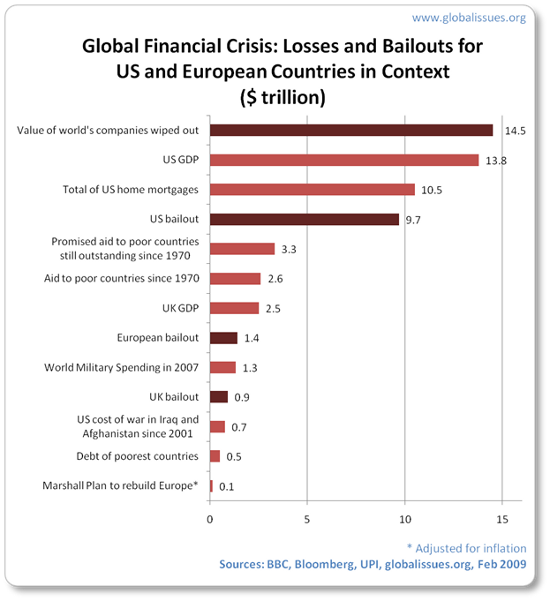
The total amounts that governments have spent on bailouts have skyrocketed. From a world credit loss of $2.8 trillion in October 2009, US taxpayers alone will spend some $9.7 trillion in bailout packages and plans, according to Bloomberg. $14.5 trillion, or 33%, of the value of the world’s companies has been wiped out by this crisis. The UK and other European countries have also spent some $2 trillion on rescues and bailout packages. More is expected.
The effect of this, the United Nation’s Conference on Trade and Development says in its Trade and Development Report 2008 is, as summarized by the Third World Network, that
the global economy is teetering on the brink of recession. The downturn after four years of relatively fast growth is due to a number of factors: the global fallout from the financial crisis in the United States, the bursting of the housing bubbles in the US and in other large economies, soaring commodity prices, increasingly restrictive monetary policies in a number of countries, and stock market volatility.
… the fallout from the collapse of the US mortgage market and the reversal of the housing boom in various important countries has turned out to be more profound and persistent than expected in 2007 and beginning of 2008. As more and more evidence is gathered and as the lag effects are showing up, we are seeing more and more countries around the world being affected by this rather profound and persistent negative effects from the reversal of housing booms in various countries.
A crisis so severe, those responsible are bailed out
Some of the bail-outs have also been accompanied with charges of hypocrisy due to the appearance of socializing the costs while privatizing the profits.
The bail-outs appear to help the financial institutions that got into trouble (many of whom pushed for the kind of lax policies that allowed this to happen in the first place).
Some governments have moved to make it harder to manipulate the markets by shorting during the financial crisis blaming them for worsening an already bad situation.
(It should be noted that during the debilitating Asian financial crisis in the late 1990s, Asian nations affected by short-selling complained, without success that currency speculators—operating through hedge funds or through the currency operations of commercial banks and other financial institutions—were attacking their currencies through short selling and in doing so, bringing the rates of the local currencies far below their real economic levels. However, when they complained to the Western governments and International Monetary Fund (IMF), they dismissed the claims of the Asian governments, blaming it on their own economic mismanagement instead.)
Other governments have moved to try and reassure investors and savers that their money is safe. In a number of European countries, for example, governments have tried to increase or fully guarantee depositors’ savings. In other cases, banks have been nationalized (socializing profits as well as costs, potentially.)
In the meanwhile, smaller businesses and poorer people rarely have such options for bail out and rescue when they find themselves in crisis.
There seems to be little sympathy—and even growing resentment—for workers in the financial sector, as they are seen as having gambled with other people’s money, and hence lives, while getting fat bonuses and pay rises for it in the past. Although in raw dollar terms the huge pay rises and bonuses are small compared to the magnitude of the problem, the encouragement such practices have given in the past, as well as the type of culture it creates, is what has angered so many people.
Nobel prize winner for economics, Paul Krugman, commenting on Bernard Madoff’s $50 billion fraud, notes that much of the financial services industry has been quite similarly corrupted:
The financial services industry has claimed an ever-growing share of the nation’s income over the past generation, making the people who run the industry incredibly rich. … The vast riches achieved by those who managed other people’s money have had a corrupting effect on our society as a whole.
… But surely those financial superstars must have been earning their millions, right? No, not necessarily. The pay system on Wall Street lavishly rewards the appearance of profit, even if that appearance later turns out to have been an illusion.
… At the crudest level, Wall Street’s ill-gotten gains corrupted and continue to corrupt politics, in a nicely bipartisan way.
How was this possible? Former chief economist of the IMF (and recently appointed Indian Prime Minister’s economic adviser), Raghuram Rajan wrote a paper back in 2005 fearing financial development in its current form may be risky . One of the main reasons was the incentive/pay mechanisms for investment managers that not only rewarded risky behavior, but perhaps encouraged it. (Because he also feared that this form of finance capitalism could have serious negative effects as well as the positive effects being seen back then, he of course was ignored and somewhat ridiculed at the time, because it was at the height of the economic boom.)
In the article mentioned above, Krugman opines that there’s an innate tendency on the part of even the elite to idolize men who are making a lot of money, and assume that they know what they’re doing.
A crisis so severe, the rest suffer too
Because of the critical role banks play in the current market system, when the larger banks show signs of crisis, it is not just the wealthy that suffer, but potentially everyone. With a globalized system, a credit crunch can ripple through the entire (real) economy very quickly turning a global financial crisis into a global economic crisis.
For example, an entire banking system that lacks confidence in lending as it faces massive losses will try to shore up reserves and may reduce access to credit, or make it more difficult and expensive to obtain.
In the wider economy, this credit crunch
and higher costs of borrowing will affect many sectors, leading to job cuts. People may find their mortgages harder to pay, or remortgaging could become expensive. For any recent home buyers, the value of their homes are likely to fall in value leaving them in negative equity. As people cut back on consumption to try and weather this economic storm, more businesses will struggle to survive leading to further further job losses.
As the above has played out, the situation has been bad enough that the International Labor Organization (ILO) has described this crisis as a global job crisis.
And so, many nations, whether wealthy and industrialized, or poor and developing, are sliding into recession if they are not already there.
The financial crisis and wealthy countries
Many blame the greed of Wall Street for causing the problem in the first place because it is in the US that the most influential banks, institutions and ideologues that pushed for the policies that caused the problems are found.
The crisis became so severe that after the failure and buyouts of major institutions, the Bush Administration offered a $700 billion bailout plan for the US financial system.
This bailout package was controversial because it was unpopular with the public, seen as a bailout for the culprits while the ordinary person would be left to pay for their folly. The US House of Representatives initial rejected the package as a result, sending shock waves around the world.
It took a second attempt to pass the plan, but with add-ons to the bill to get the additional congressmen and women to accept the plan.
However, as former Nobel prize winner for Economics, former Chief Economist of the World Bank and university professor at Columbia University, Joseph Stiglitz, argued, the plan remains a very bad bill:
I think it remains a very bad bill. It is a disappointment, but not a surprise, that the administration came up with a bill that is again based on trickle-down economics. You throw enough money at Wall Street, and some of it will trickle down to the rest of the economy. It’s like a patient suffering from giving a massive blood transfusion while there’s internal bleeding; it doesn’t do anything about the basic source of the hemorrhaging, the foreclosure problem. But that having been said, it is better than doing nothing, and hopefully after the election, we can repair the very many mistakes in it.
Writing in The Guardian, Stiglitz also added that,
Americans have lost faith not only in the [Bush] administration, but in its economic philosophy: a new corporate welfarism masquerading behind free-market ideology; another version of trickle-down economics, where the hundreds of billions to Wall Street that caused the problem were supposed to somehow trickle down to help ordinary Americans. Trickle-down hasn’t been working well in America over the past eight years.
The very assumption that the rescue plan has to help is suspect. After all, the IMF and US treasury bail-outs for Wall Street 10 years ago in Korea, Thailand, Indonesia, Brazil, Russia and Argentina didn't work for those countries, although it did enable Wall Street to get back most of its money. The taxpayers in these other poor countries picked up the tab for the financial markets’ mistakes. This time, it is American taxpayers who are being asked to pick up the tab. And that’s the difference. For all the rhetoric about democracy and good governance, the citizens in those countries didn’t really get a chance to vote on the bail-outs.
…
In environmental economics, there is a basic concept called the polluter pays principle. It is a matter of fairness, but also of efficiency. Wall Street has polluted our economy with toxic mortgages. It should now pay for the cleanup.
In Europe, starting with Britain, a number of nations decided to nationalize, or part-nationalize, some failing banks to try and restore confidence. The US resisted this approach at first, as it goes against the rigid free market view the US has taken for a few decades now.
Eventually, the US capitulated and the Bush Administration announced that the US government would buy shares in troubled banks.
This illustrates how serious this problem is for such an ardent follower of free market ideology to do this (although free market theories were not originally intended to be applied to finance, which could be part of a deeper root cause of the problem).
Perhaps fearing an ideological backlash, Bush was quick to say that buying stakes in banks is not intended to take over the free market, but to preserve it.
Professor Ha-Joon Chang of Cambridge University suggests that historically America has been more pragmatic about free markets than their recent ideological rhetoric suggests, a charge by many in developing countries that rich countries are often quite protectionist themselves but demand free markets from others at all times.
While the US move was eventually welcomed by many, others echo Stiglitz’s concern above. For example, former Assistant Secretary of the Treasury Department in the Reagan administration and a former associate editor of the Wall Street Journal, Paul Craig Roberts also argues that the bailout should have been to help people with failing mortgages, not banks: The problem, according to the government, is the defaulting mortgages, so the money should be directed at refinancing the mortgages and paying off the foreclosed ones. And that would restore the value of the mortgage-backed securities that are threatening the financial institutions [and] the crisis would be over. So there’s no connection between the government’s explanation of the crisis and its solution to the crisis.
(Interestingly, and perhaps the sign of the times, while Europe and US consider more socialist-like policies, such as some form of nationalization, China seems to be contemplating more capitalist ideas, such as some notion of land reform, to stimulate and develop its internal market. This, China hopes, could be one way to try and help insulate the country from some of the impacts of the global financial crisis.)
Despite the large $700 billion US plan, banks have still been reluctant to lend. This led to the US Fed announcing another $800 billion stimulus package at the end of November. About $600bn is marked to buy up mortgage-backed securities while $200bn will be aimed at unfreezing the consumer credit market. This also reflects how the crisis has spread from the financial markets to the real economy
and consumer spending.
By February 2009, according to Bloomberg, the total US bailout is $9.7 trillion. Enough to pay off more than 90 percent of America’s home mortgages (although this bailout barely helps homeowners).
And for many months concern has been growing about where the US bailout money is actually going. It seems that there has been a bit of tension between the US Treasury and Congress. Interviewing Special Inspector General Barofsky, Inter Press Service notes, The Treasury has called [auditing spending of bailout money]
meaningless
, Barofsky said.
The Treasury has refused to audit the money loaned to the banks to see how they are spending it.
… So Barofsky’s office went ahead and pursued the information.
The office surveyed 360 banks that received Treasury bailout funds and found that almost all were using the money in ways other than to lend — which was the intent of the program. The banks used some of the funds to lend, but also to purchase other banks, to pay off debts and to simply hold in reserve should they need the funds in the future.
TARP [Troubled Asset Relief Program] has become a program in which taxpayers are not being told what most of the TARP recipients are doing with their money, have still not been told how much their substantial investments are worth, and will not be told the full details of how their money is being invested,Barofsky said.
A crisis signaling the decline of US’s superpower status?
Even before this global financial crisis took hold, some commentators were writing that the US was in decline, evidenced by its challenges in Iraq and Afghanistan, and its declining image in Europe, Asia and elsewhere.
The BBC also asked if the US’s superpower status was shaken by this financial crisis:
The financial crisis is likely to diminish the status of the United States as the world’s only superpower. On the practical level, the US is already stretched militarily, in Afghanistan and Iraq, and is now stretched financially. On the philosophical level, it will be harder for it to argue in favor of its free market ideas, if its own markets have collapsed.
… Some see this as a pivotal moment.
The political philosopher John Gray, who recently retired as a professor at the London School of Economics, wrote in the London paper The Observer: “Here is a historic geopolitical shift, in which the balance of power in the world is being altered irrevocably.
The era of American global leadership, reaching back to the Second World War, is over… The American free-market creed has self-destructed while countries that retained overall control of markets have been vindicated.…
How symbolic that Chinese astronauts take a spacewalk while the US Treasury Secretary is on his knees.
Yet, others argue that it may be too early to write of the US:
The director of a leading British think-tank Chatham House, Dr Robin Niblett … argues that we should wait a bit before coming to a judgment and that structurally the United States is still strong.
America is still immensely attractive to skilled immigrants and is still capable of producing a Microsoft or a Google,he went on. “Even its debt can be overcome. It has enormous resilience economically at a local and entrepreneurial level.“And one must ask, decline relative to who? China is in a desperate race for growth to feed its population and avert unrest in 15 to 20 years. Russia is not exactly a paper tiger but it is stretching its own limits with a new strategy built on a flimsy base. India has huge internal contradictions. Europe has usually proved unable to jump out of the doldrums as dynamically as the US.
But the US must regain its financial footing and the extent to which it does so will also determine its military capacity. If it has less money, it will have fewer forces.
Europe and the financial crisis
In Europe, a number of major financial institutions failed. Others needed rescuing.
In Iceland, where the economy was very dependent on the finance sector, economic problems have hit them hard. The banking system virtually collapsed and the government had to borrow from the IMF and other neighbors to try and rescue the economy. In the end, public dissatisfaction at the way the government was handling the crisis meant the Iceland government fell.
A number of European countries have attempted different measures (as they seemed to have failed to come up with a united response).
For example, some nations have stepped in to nationalize or in some way attempt to provide assurance for people. This may include guaranteeing 100% of people’s savings or helping broker deals between large banks to ensure there isn’t a failure.
The EU is also considering spending increases and tax cuts said to be worth €200bn over two years. The plan is supposed to help restore consumer and business confidence, shore up employment, getting the banks lending again, and promoting green technologies.
Russia’a economy is contracting sharply with many more feared to slide into poverty. One of Russia’s key exports, oil, was a reason for a recent boom, but falling prices have had a big impact and investors are withdrawing from the country.
Structural Adjustment for Industrialized Nations
For decades, structural adjustment policies in the developing nations (often strongly encouraged by the wealthy nations) has created poverty or made things worse.
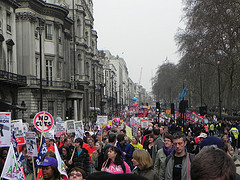
Now, with such a severe financial crisis industrialized nations from Greece, to UK and others are contemplating strong austerity measures and cutbacks on public services — much like the structural adjustment the developing world had to endure for as much as 2 decades.
For example, UK’s new government has come in mostly on a platform of blaming the previous government for causing the crisis, ignoring the neoliberal ideological influences on government policy from the private sector or from their own party before the Labour Party had come into power (though New
Labour also encouraged the same thinking). As such, the new Conservative government has insisted that because of high spending of the past government, they have no alternative but to cut back on all manner of social spending (all while various bankers get ready to be rewarded with more bonuses!).
Yet, as Professor Ha Joon Chang noted at the end of 2010, the fall in tax revenues has made the deficit hard to sustain, not government spending per se: Companies and individuals have been unable to earn as much as before the recession so the fall in that revenue for governments leaves their previously high spending look like immense bureaucratic waste holes.
Bringing about sustainable and appropriate growth is more important than cuts to areas that didn’t cause the problem he seems to imply, while not enough is being done to prevent future crises of the same type. Excessive cuts, he warns, can even push a country further into recession if it is not addressing the core causes of the crisis in the first place.
Stories of strikes and protests are increasingly commonplace, and if the experience of developing nations are anything to go by in previous decades, similar protests are likely in the future in industrialized nations.
One such example is in Ireland that has recently seen a bailout package from the EU, IMF and others require an austerity budget, much like the harmful structural adjustment policies the developing world went through. Other Eurozone countries such as Portugal, Italy, Greece and Spain are also facing potential problems, while Iceland has gone through many in the past.
Former Nobel prize winner for economics, Paul Krugman compared Iceland and Ireland’s handling of the situation and found that Ireland’s situation is potentially worse than Iceland’s because the Irish government stepped in to guarantee the banks’ debt, turning private losses into public obligations.
Ireland’s economic growth turned to disaster when speculative frenzy, driven by banks and the real estate sector, and possibly corrupt politicians, ended with banks bursting. Ireland’s credit-worthiness in the international markets was under fire so it took on austerity measures. So, in effect, actions by banks and others have left the nation in recession, with the public bailing them out, while taking on the effects to their economy; a double-whammy so to speak.
As Krugman ends, punishing the Irish population for the mistakes of the banks and others is a terrible mistake. By contrast, Krugman also notes that Iceland’s banks had to pay for their mistakes, leading to a decline in Iceland’s external debt. (Other measures including temporary capital controls also helped. Iceland’s own currency, the Krona, instead of Euro may have helped it too as it was able to devalue its currency, making its exports more competitive and thus helping it somewhat.)
Ireland is now in a tough spot as protesters have a legitimate cause to be concerned while others are worried that if actions such as considering increasing corporate tax are entertained, major multinationals that have been part of Ireland’s recent boom, may make good on their threat to move to other places that are more favorable to them although the $100bn bailout conditions currently do not require that.
Focusing on debt instead of the economy
In the US, the Democracy Now! show reveals how billionaire investors have helped reshape the national debate on the economy, the debt and social spending. Some have contributes hundreds of millions of dollars to push Congress to cut Social Security, Medicare and Medicaid — while providing tax breaks for corporations and the wealthy. Campaigns such as Fix the Debt
are portrayed as a citizen-led effort, while critics find them to be fronts for business groups.
And of course, special interests and ideology are at play as John Nicols, part of a group who exposed some of these findings, noted:
What they are really arguing for is a systematized austerity, one where you have very, very wealthy people deciding what sort of fixes we will have for our economy. And at the end of the day, invariably, the fix will be to lower their tax rates while at the same time taking deep cuts out of the earned benefit programs that Americans desperately need.
Fix the DebtCampaign Exposed , Democracy Now!, February 26, 2013
Democracy Now!’s full video is here:
Fix the DebtCampaign Exposed, Democracy Now!, February 26, 2013
In his own article in the Nation magazine John Nichols added. The Fix the Debt project, financed by corporations and billionaires, seeks to buy that influence after its proposals were rejected by the voters. That’s not democracy; that’s plutocracy.
That comes from his article, The Austerity Agenda: An Electoral Loser. In that article he also describes how some of the phony campaigns work in a 2-minute video:
Fix the DebtCampaign’s Astroturf Roots, February 22, 2013
Presumably other countries may also have such cynical political campaigns, too.
Austerity as ideological opportunity
As prominent economist Ha Joon Chang has written many times, the UK's problems go far deeper than the cuts agenda. It simply can’t produce enough to revive its ailing economy. Furthermore, as has been said by many for many years, the approach by some governments, such as the UK’s current coalition government (with the Conservatives as the main party) is ideological:
British debate on economic policy is getting nowhere. The coalition government keeps repeating that it has to cut spending in order to cut deficits, no matter what. The opposition has been at pains to explain … that trying to cut deficits by cutting spending in a stagnant economy is a largely self-defeating exercise, as it reduces growth and thus tax revenue.
…
In reality, though, the coalition government isn't as stupid or stubborn as it appears. It is sticking to its plan A because spending cuts are not about deficits but about rolling back the welfare state. So no amount of evidence is going to change its position on cuts.
And history seems to show that austerity has never worked and has always led to recession. Or maybe put another way, it has typically worked for the elite looking to maintain a system from which they benefit.
Austerity without economic growth = backwards development
For UK in particular, as Chang continues, despite a huge devaluation in the sterling currency, it has still been unable to generate a trade surplus. UK’s over-reliance on financial services may also be a cause for long-term concern. And as manufacturing shows mixed signals, luxury goods show a general healthy sign and exports of raw resources are doing better than finished manufacturing products, these all hint to growing inequality and potential growing poverty and stagnation. Or as Chang puts it, putting all this in context, since the crisis the British economy has been moving backwards in terms of its sophistication as a producer.
In the middle of 2012, the United Nations also warned that the problems in European were bad not just for Europe, but for the world economy too. The policy of austerity was criticized by the UN as heading in the wrong direction
. The fiscal austerity programs implemented in several European countries are ineffective to help the economy emerge from crisis, it said, according to Inter Press Service.
Lost decade?
A few are now suggesting that some European countries may be facing a lost decade or a lost youth generation. A Nobel laureate in economics, Joseph Stiglitz, writes,
It will take 10 years or more to recover the losses incurred in this austerity process.
…
Europe’s talents and resources – its physical, human, and natural capital – are the same today as they were before the crisis began. The problem is that the prescriptions imposed are leading to massive under-utilisation of these resources. Whatever Europe's problem, a response that entails waste on this scale cannot be the solution.
While many talk of a lost decade, it is worth remembering that similar austerity programs imposed on most of the developing world in the form of Structural Adjustment Programs amounted to a loss of 2 decades.
Those policies largely driven by IMF policies influenced by the US and European countries now seem ironic as Chang also notes:
Given … recent [reform] changes in the IMF, it is ironic to see the European governments inflicting an old-IMF-style program on their own populations. It is one thing to tell the citizens of some faraway country to go to hell but it is another to do the same to your own citizens, who are supposedly your ultimate sovereigns. Indeed, the European governments are out-IMF-ing the IMF in its austerity drive so much that now the fund itself frequently issues the warning that Europe is going too far, too fast.
So as well as a loss of economic productivity and livelihoods that come through it, people’s rights and democracy are also undermined by this process of austerity:
Instead of [austerity] being explicitly cast as a rewriting of the social contract, changing people’s entitlements and changing the way the society establishes its legitimacy, the dismembering of the welfare state is presented as a technocratic exercise of
balancing the books. Democracy is neutered in the process and the protests against the cuts are dismissed. The description of the externally imposed Greek and Italian governments astechnocraticis the ultimate proof of the attempt to make the radical rewriting of the social contract more acceptable by pretending that it isn't really a political change.The danger is not only that these austerity measures are killing the European economies but also that they threaten the very legitimacy of European democracies – not just directly by threatening the livelihoods of so many people and pushing the economy into a downward spiral, but also indirectly by undermining the legitimacy of the political system through this backdoor rewriting of the social contract.
So why can’t countries just declare themselves bankrupt like companies can? As Chang explains in another article, there aren’t the same processes available for countries as there are for companies:
It is not because people condoned defaulting per se that they came to introduce the corporate bankruptcy law. It was because they recognized that in the long run, creditors – and the broader economy, too – are likely to benefit more from reducing the debt burdens of companies in trouble, so that they can get a fresh start, than by letting them disintegrate in a disorderly way.
It is high time that we applied the same principles to countries and introduced a sovereign bankruptcy law.
The financial crisis and the developing world
For the developing world, the rise in food prices as well as the knock-on effects from the financial instability and uncertainty in industrialized nations are having a compounding effect. High fuel costs, soaring commodity prices together with fears of global recession are worrying many developing country analysts.
Summarizing a United Nations Conference on Trade and Development report, the Third World Network notes the impacts the crisis could have around the world, especially on developing countries that are dependent on commodities for import or export:
Uncertainty and instability in international financial, currency and commodity markets, coupled with doubts about the direction of monetary policy in some major developed countries, are contributing to a gloomy outlook for the world economy and could present considerable risks for the developing world, the UN Conference on Trade and Development (UNCTAD) said Thursday.
… Commodity-dependent economies are exposed to considerable external shocks stemming from price booms and busts in international commodity markets.
Market liberalization and privatization in the commodity sector have not resulted in greater stability of international commodity prices. There is widespread dissatisfaction with the outcomes of unregulated financial and commodity markets, which fail to transmit reliable price signals for commodity producers. In recent years, the global economic policy environment seems to have become more favorable to fresh thinking about the need for multilateral actions against the negative impacts of large commodity price fluctuations on development and macroeconomic stability in the world economy.
Asia and the financial crisis
Countries in Asia are increasingly worried about what is happening in the West. A number of nations urged the US to provide meaningful assurances and bailout packages for the US economy, as that would have a knock-on effect of reassuring foreign investors and helping ease concerns in other parts of the world.
Many believed Asia was sufficiently decoupled from the Western financial systems. Asia has not had a subprime mortgage crisis like many nations in the West have, for example. Many Asian nations have witnessed rapid growth and wealth creation in recent years. This lead to enormous investment in Western countries. In addition, there was increased foreign investment in Asia, mostly from the West.
However, this crisis has shown that in an increasingly inter-connected world means there are always knock-on effects and as a result, Asia has had more exposure to problems stemming from the West. Many Asian countries have seen their stock markets suffer and currency values going on a downward trend. Asian products and services are also global, and a slowdown in wealthy countries means increased chances of a slowdown in Asia and the risk of job losses and associated problems such as social unrest.
India and China are the among the world’s fastest growing nations and after Japan, are the largest economies in Asia. From 2007 to 2008 India’s economy grew by a whopping 9%. Much of it is fueled by its domestic market. However, even that has not been enough to shield it from the effect of the global financial crisis, and it is expected that in data will show that by March 2009 that India’s growth will have slowed quickly to 7.1%. Although this is a very impressive growth figure even in good times, the speed at which it has dropped—the sharp slowdown—is what is concerning.
China, similarly has also experienced a sharp slowdown and its growth is expected to slow down to 8% (still a good growth figure in normal conditions). However, China also has a growing crisis of unrest over job losses. Both have poured billions into recovery packages.
With China concerned about its economy, it has been trying to encourage its companies to invest more overseas, hoping it will reduce the upward pressure on its currency, the Yuan.
China has also raised concerns about the world relying on mostly one foreign currency reserve, and called for the dollar to be replaced by a world reserve currency run by the IMF. Of course, the US has defended the dollar as a global currency reserve, which is to be expected given it is one of its main sources of global economic dominance. Whether a change like this would actually happen remains to be seen, but it is likely the US and its allies will be very resistant to the idea.
Japan, which has suffered its own crisis in the 1990s also faces trouble now. While their banks seem more secure compared to their Western counterparts, it is very dependent on exports. Japan is so exposed that in January alone, Japan’s industrial production fell by 10%, the biggest monthly drop since their records began.
Japan’s output for the first 3 months of 2009 plunged at its quickest pace since records began in 1955, mostly due to falling exports. A rise in industrial output in April was expected, but was positively more than initially estimated. However, with high unemployment and general lack of confidence, optimism for recovery has been dampened.
Towards the end of October 2008, a major meeting between the EU and a number of Asian nations resulted in a joint statement pledging a coordinated response to the global financial crisis. However, as Inter Press Service (IPS) reported, this coordinated response is dependent on the entry of Asia’s emerging economies into global policy-setting institutions.
This is very significant because Asian and other developing countries have often been treated as second-class citizens when it comes to international trade, finance and investment talks. This time, however, Asian countries are potentially trying to flex their muscle, maybe because they see an opportunity in this crisis, which at the moment mostly affects the rich West.
Asian leaders had called for effective and comprehensive reform of the international monetary and financial systems.
For example, as IPS also noted in the same report, one of the Chinese state-controlled media outlets demanded that We want the U.S. to give up its veto power at the International Monetary Fund and European countries to give up some more of their voting rights in order to make room for emerging and developing countries.
They also added, And we want America to lower its protectionist barriers allowing an easier access to its markets for Chinese and other developing countries’ goods.
Whether this will happen is hard to know. Similar calls by other developing countries and civil society around the world, for years, have come to no avail. This time however, the financial crisis could mean the US is less influential than before. A side-story of the emerging Chinese superpower versus the declining US superpower will be interesting to watch.
It would of course be too early to see China somehow using this opportunity to decimate the US, economically, as it has its own internal issues. While the Western mainstream media has often hyped up a threat
posed by a growing China, the World Bank’s chief economist (Lin Yifu, a well respected Chinese academic) notes Relatively speaking, China is a country with scarce capital funds and it is hardly the time for us to export these funds and pour them into a country profuse with capital like the U.S.
China has, however, used this opportunity to attempt to attract neighboring nations into its orbit by attempting to foster better economic ties. According to an IPS analysis, this has been a goal for a while, but the recent financial crisis has provided more opportunities for China to step up to this.
An improved investment deal between China and Taiwan maybe one example of this improving engagement in the region. The economic crisis may also be encouraging greater ties in this manner, as it would be important for Taiwan in particular (as it has been in recession since the end of 2008).
Asian nations are mulling over the creation of an alternative Asia foreign exchange fund, but market shocks are making some Asian countries nervous and it is not clear if all will be able to commit.
What seems to be emerging is that Asian nations may have an opportunity to demand more fairness in the international arena, which would be good for other developing regions, too.
Africa and the financial crisis
Perhaps ironically, Africa’s generally weak integration with the rest of the global economy may mean that many African countries will not be affected from the crisis, at least not initially, as suggested by Reuters in September 2008.
The wealthier ones who do have some exposure to the rest of the world, however, may face some problems.
In recent years, there has been more interest in Africa from Asian countries such as China. As the financial crisis is hitting the Western nations the hardest, Africa may yet enjoy increased trade for a while.
These earlier hopes for Africa, above, may be short lived, unfortunately. In May 2009, the International Monetary Fund (IMF) warned that Africa’s economic growth will plummet because of the world economic downturn, predicting growth in sub-Saharan Africa will slow to 1.5% in 2009, below the rate of population growth (revising downward a March 2009 prediction of 3.25% growth due to the the slump in commodity prices and the credit squeeze).
South Africa, Africa’s largest economy, has entered into recession for the first time since 1992, due to a sharp decline in the key manufacturing and mining sectors.
The IMF has promised more aid to the region, importantly with looser conditions, which in the past have been very detrimental to Africa. Many will likely remain skeptical of IMF loans given this past, as Stiglitz and others have already voiced concerns about (see further below).
In the long run, it can be expected that foreign investment in Africa will reduce as the credit squeeze takes hold. Furthermore, foreign aid, which is important for a number of African countries, is likely to diminish. (Effectiveness of aid is a separate issue which the previous link details.)
African countries could face increasing pressure for debt repayment, however. As the crisis gets deeper and the international institutions and western banks that have lent money to Africa need to shore up their reserves more, one way could be to demand debt repayment. This could cause further cuts in social services such as health and education, which have already been reduced due to crises and policies from previous eras.
Much of the debts owed by African nations are odious, or unjust debts, as detailed further below, which would make any more aggressive demands of repayment all the more worrisome.
Some African countries have already started to cut their health and HIV budgets due to the economic crisis. Their health budgets and resources have been constrained for many years already, so this crisis makes a bad situation worse. As IPS reports,
Already, large percentages of households in Sub-Saharan Africa are poor, and the large number of people on treatment means ever-increasing treatment program costs.
Yet, Sub-Saharan Africa only accounts for one percent of global health expenditure and two percent of the global health workforce. Currently, only one third of HIV-positive Africans in need of antiretroviral (ARV) treatment can access it.
… Dr Bactrin Killingo, chairperson of the Nairobi-based Collaborative Fund for HIV Treatment Preparedness [says, ]
If current cost constraints faced by HIV treatment programmes are not addressed, while the demand for expensive second-line treatment increases, we will soon find ourselves in a situation similar to the 1990s, where millions of lives were lost unnecessarily because people could not afford the treatment they needed to stay alive.
And it is not just poor nations’ health funds at risk. IPS adds that even international donor organizations have started to feel the financial crunch:
The Global Fund to Fight AIDS, Tuberculosis and Malaria recently announced it is at least $4 billion short of the money it will need to continue funding essential HIV, TB and malaria services in 2010. The coalition believes there is a $10.7 billion funding gap for regional implementation of the Global Plan to Stop TB alone.
Latin America and the financial crisis
Much of Latin America depends on trade with the United States (which absorbs half of Latin America’s exports, alone, for example). As such Latin America will also feel the effect of the US financial crisis and slower growth in Latin America is expected.
Due to its proximity to the US and its close relationship via the NAFTA and other agreements, Mexico is expected to have one of the lowest growth rates for the region next year at 1.9%, compared to a downgraded forecast of 3% for the rest of the region.
A number of countries in the region have come together in the form of the Latin American Pacific Arc and are hoping to improve trade and investment with Asia. Diversifying in this way might be good for the region and help provide some stability against future crises. For the moment, the integration is going ahead, despite concerns about the financial crisis.
However, the problems of a regional blocs, Mercosur (the Southern Common Market), shows that not all is well. While Mercosur is its relevance being questioned, an IPS overview of its recent challenges also highlights that a number of South American countries are raising trade barriers against their neighbors as the crisis starts to bite more. Rather than regional integration and a unified position to present to the rest of the world, concerns of fragmentation are increasing. This also affects Brazil, as the regional economic superpower; more bickering within its sphere means distraction from the global scene.
A crisis in context
While much mainstream media attention is on the details of the financial crisis, and some of its causes, it also needs to be put into context (though not diminishing its severity).
Plummeting stock markets have wiped out 33% of the value of companies, $14.5 trillion. Taxpayers will be bailing out their banks and financial institutions with large amounts of money. US taxpayers alone will spend some $9.7 trillion in bailout packages and plans, according to Bloomberg. The UK and other European countries have also spent some $2 trillion on rescues and bailout packages. More is expected. Much more.
Such numbers, made quickly available, are enough to wipe many individual’s mortgages, or clear out third world debt many times over. Even the high military spending figures are dwarfed by the bailout plans to date.
A crisis of poverty for much of humanity
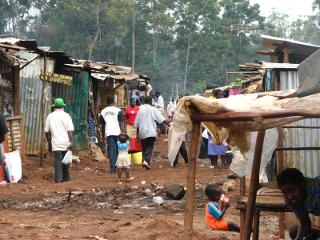
In poorer countries, poverty is not always the fault of the individual alone, but a combination of personal, regional, national, and—importantly—international influences. There is little in the way of bail out for these people, many of whom are not to blame for their own predicament, unlike with the financial crisis.
There are some grand strategies to try and address global poverty, such as the UN Millennium Development Goals, but these are not only lofty ideals and under threat from the effects of the financial crisis (which would reduce funds available for the goals), but they only aim to halve poverty and other problems. While this of course is better than nothing it signifies that many leading nations have not had the political will to go further and aim for more ambitious targets, but are willing to find far more to save their own banks, for example.
A global food crisis affecting the poorest the most
While the media’s attention is on the global financial crisis (which predominantly affects the wealthy and middle classes), the effects of the global food crisis (which predominantly affects the poorer and working classes) seems to have fallen off the radar.
The two are in fact inter-related issues, both have their causes rooted in the fundamental problems associated with a neoliberal, one-size-fits-all, economic agenda imposed on virtually the entire world.
Human rights conditions made worse by the crisis
Human rights has long been a concern. Recent years have seen increasing acknowledgment that human rights and economic issues such as development go hand in hand.
Long before the global financial crisis took hold, human rights concerns were high the world over, as annual reports from Amnesty International and other human rights organizations repeatedly warned about.
The global financial crisis has led to an economic crisis which in turn has led to a human rights crisis, says Amnesty in their 2009 report.
They find that as millions more slide into poverty as a result of the current crisis, social unrest increases resulting in more protests. These protests are sometimes met with a lot of suppression. Other times, people are exploited further.
The World Bank agrees. According to the BBC, the World Bank has warned of a human catastrophe
in the world’s poorest countries unless more is done to tackle the global economic crisis and fears massive social upheaval if more is not done to address the crisis.
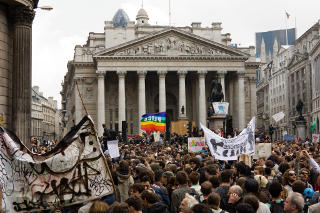
When the G20 held a summit in UK in April 2009, much was made by local media about the apparent use of excessive force by police against protesters, and even led to the death of a passer by mistaken as a protester (a small minority of whom were also violent). (George Monbiot also raises concerns about how campaigners and protesters are being rebranding as domestic extremists
.)
But as a news article accompanying the report from Amnesty summarizes, many nations have seen protests against economic decline and social conditions which have been met by violence, arrests and detentions without charge:
Across Africa, people demonstrated against desperate social and economic situations and sharp rises in living costs. … Some demonstrations turned violent; the authorities often repressed protests with excessive force.
Social tensions and economic disparities led to thousands of protests throughout China. In the Americas, social protest at economic conditions increased in Peru; in Chile there were demonstrations throughout 2008 on Indigenous People’s rights and rising living costs.
In the Middle East and North Africa, the economic and social insecurity was highlighted by strikes and protests in several countries, including Egypt. In Tunisia, strikes and protests were put down with force, causing two deaths, many injuries and more than 2,000 prosecutions of alleged organizers, some culminating in long prison sentences.
Poor nations will get less financing for development
The poorer countries do get foreign aid from richer nations, but it cannot be expected that current levels of aid (low as they actually are) can be maintained as donor nations themselves go through financial crisis. As such the Millennium Development Goals to address many concerns such as halving poverty and hunger around the world, will be affected.
Almost an aside, the issue of tax havens is important for many poor countries. Tax havens result in capital moving out of poor countries into havens. An important source of revenue, domestic tax revenues account for just 13% of low income countries’ earnings, whereas it is 36% for the rich countries, as Inter Press Service notes.
A UN-sponsored conference slated for November 2008 to address this issue is unlikely to get much attention or be successful due to the recession fears and the financial crisis. But this capital flight is estimated to cost poor countries from $350 billion to $500 billion in lost revenue, outweighing foreign aid by almost a factor of 5.
This lost tax revenue is significant for poor countries. It could reduce, or eliminate the need for foreign aid (which many in rich countries do not like giving, anyway), could help poor countries pay off (legitimate) debts, and also help themselves become more independent from the influence of wealthy creditor nations.
Politically, it may be this latter point that prevents many rich countries doing more to help the poor, when monetarily it would be so easy to do so.
But public pressure has had an effect. Governments of the US, UK and others are slowly increasing pressure on tax havens, though with mixed results, and some tax havens are on the defensive, some trying to justify themselves.
Some havens, such as Jersey have been pressured into signing agreements that will increase their transparency. Whether it will work, or if it is just a token gesture is hard to say at this time, however.
For more on this aspect, see this site’s section on tax evasion and tax havens.
Odious third world debt has remained for decades; Banks and military get money easily
Crippling third world debt has been hampering development of the developing countries for decades. These debts are small in comparison to the bailout the US alone was prepared to give its banks, but enormous for the poor countries that bear those burdens, having affected many millions of lives for many, many years.
Many of these debts were incurred not just by irresponsible government borrowers (such as corrupt third world dictators, many of whom had come to power with Western backing and support), but irresponsible lending (also a moral hazard) from Western banks and institutions they heavily influenced, such as the IMF and World Bank.
Despite enormous protest and public pressure for odious debt relief or write-off, hardly any has occurred, and when it does grand promises of debt relief for poor countries often turn out to be exaggerated. One recently described historic breakthrough
debt relief was announced as a $40 billion debt write-off but turned out to be closer to $17 billion in real terms. To achieve even this amount required much campaigning and pressuring of the mainstream media to cover these issues.
By contrast, the $700 billion US bail out as well as bailouts by other rich country governments were very quick to put in place. The money then seemed easy to find. Talk of increasing health or education budgets in rich countries typically meets resistance. Massive military spending, or now, financial sector bail out, however, can be done extremely quickly.
And, a common view in many countries seems to be how financial sector leaders get away
with it. For example, a hungry person stealing bread is likely to get thrown into jail. A financial sector leader, or an ideologue pushing for policies that are going to lead to corruption or weaknesses like this, face almost no such consequence for their action other than resigning from their jobs and perhaps public humiliation for a while.
A crisis that need not have happened
This problem could have been averted (in theory) as people had been pointing to these issues for decades. Yet, of course, during periods of boom no-one (let alone the financial institutions and their supporting ideologues and politicians largely believed to be responsible for the bulk of the problems) would want to hear of caution and even thoughts of the kind of regulation that many are now advocating. To suggest anything would be anti-capitalism or socialism or some other label that could effectively shut up even the most prominent of economists raising concerns.
Of course, the irony that those same institutions would now themselves agree that those anti-capitalist
regulations are required is of course barely noted. Such options now being considered are not anti-capitalist. However, they could be described as more regulatory or managed rather than completely free or laissez faire capitalism, which critics of regulation have often preferred. But a regulatory capitalist economy is very different to a state-based command economy, the style of which the Soviet Union was known for. The points is that there are various forms of capitalism, not just the black-and-white capitalism and communism. And at the same time, the most extreme forms of capitalism can also lead to the bigger bubbles and the bigger busts.
Quoting Stiglitz again, he captures the sentiments of a number of people:
We had become accustomed to the hypocrisy. The banks reject any suggestion they should face regulation, rebuff any move towards anti-trust measures — yet when trouble strikes, all of a sudden they demand state intervention: they must be bailed out; they are too big, too important to be allowed to fail.
…
America’s financial system failed in its two crucial responsibilities: managing risk and allocating capital. The industry as a whole has not been doing what it should be doing … and it must now face change in its regulatory structures. Regrettably, many of the worst elements of the US financial system … were exported to the rest of the world.
Some of these regulatory measures have been easy to get around for various reasons. Some reasons for weak regulation that entrepreneur Mark Shuttleworth describes include that regulators
- Are poorly paid or are not the best talent
- Often lack true independence (or are corrupted by industries lobbying for favors)
- May lack teeth or courage in face of hostile industries and a politically hostile climate to regulation.
Given its crucial role, it is extremely important to invest in it too, Shuttleworth stresses.
However, this crisis wasted almost a generation of talent:
It was all done in the name of innovation, and any regulatory initiative was fought away with claims that it would suppress that innovation. They were innovating, all right, but not in ways that made the economy stronger. Some of America’s best and brightest were devoting their talents to getting around standards and regulations designed to ensure the efficiency of the economy and the safety of the banking system. Unfortunately, they were far too successful, and we are all — homeowners, workers, investors, taxpayers — paying the price.
Paul Krugman also notes the wasted talent, at the expense of other areas in much need:
How much has our nation’s future been damaged by the magnetic pull of quick personal wealth, which for years has drawn many of our best and brightest young people into investment banking, at the expense of science, public service and just about everything else?
The wasted capital, labor and resources all add up.
British economist John Maynard Keynes, is considered one of the most influential economists of the 20th century and one of the fathers of modern macroeconomics. He advocated an interventionist form of government policy believing markets left to their own measure (i.e. completely freed
) could be destructive leading to cycles of recessions, depressions and booms. To mitigate against the worst effects of these cycles, he supported the idea that governments could use various fiscal and monetary measures. His ideas helped rebuild after World War II, until the 1970s when his ideas were abandoned for freer market systems.
Keynes’ biographer, professor Robert Skidelsky, argues that free markets have undermined democracy and led to this crisis in the first place:
What creates a crisis of the kind that now engulfs us is not economics but politics. The triumph of the global
freemarket, which has dominated the world over the last three decades has been a political triumph.It has reflected the dominance of those who believe that governments (for which read the views and interests of ordinary people) should be kept away from the levers of power, and that the tiny minority who control and benefit most from the economic process are the only people competent to direct it.
This band of greedy oligarchs have used their economic power to persuade themselves and most others that we will all be better off if they are in no way restrained—and if they cannot persuade, they have used that same economic power to override any opposition. The economic arguments in favor of free markets are no more than a fig leaf for this self-serving doctrine of self-aggrandizement.
Furthermore, he argues that the democratic process has been abused and manipulated to allow a concentration of power that is actually against the idea of free markets and real capitalism:
The uncomfortable truth is that democracy and free markets are incompatible. The whole point of democratic government is that it uses the legitimacy of the democratic mandate to diffuse power throughout society rather than allow it to accumulate—as any player of Monopoly understands—in just a few hands. It deliberately uses the political power of the majority to offset what would otherwise be the overwhelming economic power of the dominant market players.
If governments accept, as they have done, that the
freemarket cannot be challenged, they abandon, in effect, their whole raison d'etre. Democracy is then merely a sham. … No amount of cosmetic tinkering at the margins will conceal the fact that power has passed to that handful of people who control the global economy.
Despite Keynesian economics getting a bad press from free market advocates for many years, many are now turning to his policies and ideas to help weather the economic crisis.
We are all Keynesians now. Even the right in the United States has joined the Keynesian camp with unbridled enthusiasm and on a scale that at one time would have been truly unimaginable.
… after having been left in the wilderness, almost shunned, for more than three decades … what is happening now is a triumph of reason and evidence over ideology and interests.
Economic theory has long explained why unfettered markets were not self-correcting, why regulation was needed, why there was an important role for government to play in the economy. But many, especially people working in the financial markets, pushed a type of
market fundamentalism.The misguided policies that resulted — pushed by, among others, some members of President-elect Barack Obama’s economic team — had earlier inflicted enormous costs on developing countries. The moment of enlightenment came only when those policies also began inflicting costs on the US and other advanced industrial countries.…
The neo-liberal push for deregulation served some interests well. Financial markets did well through capital market liberalization. Enabling America to sell its risky financial products and engage in speculation all over the world may have served its firms well, even if they imposed large costs on others.
Today, the risk is that the new Keynesian doctrines will be used and abused to serve some of the same interests.
Some of the world’s top financiers and officials are reluctantly accepting that the version of capitalism that has long favored them may not be good for everyone.
At the end of 2008, Alan Greenspan was summoned to the U.S. Congress to testify about the financial crisis. His tenure at the Federal Reserve had been long and lauded, and Congress wanted to know what had gone wrong. Henry Waxman questioned him:
- Greenspan:
I found a flaw in the model that I perceived is the critical functioning structure that defines how the world works, so to speak.
- Waxman:
In other words, you found that your view of the world, your ideology, was not right, it was not working.
- Greenspan:
Precisely. That is precisely the reason I was shocked, because I had been going for 40 years or more with very considerable evidence that it was working exceptionally well.
[Greenspan’s flaw] warped his view about how the world was organized, about the sociology of the market. And Greenspan is not alone. Larry Summers, the president’s senior economic advisor, has had to come to terms with a similar error—his view that the market was inherently self-stabilizing has been
dealt a fatal blow.Hank Paulson, Bush’s treasury secretary, has shrugged his shoulders with similar resignation. Even Jim Cramer from CNBC’s Mad Money admitted defeat:The only guy who really called this right was Karl Marx.One after the other, the celebrants of the free market are finding themselves, to use the language of the market, corrected.
Stiglitz observed this remarkable resignation at the annual Davos forum, usually a meeting place of rich world leaders and the corporate elite, who usually together reassert ways to go full steam ahead with a form of corporate globalization that has benefited those at the top. This time, however, Stiglitz noted that
[There was a] striking … loss of faith in markets. In a widely attended brainstorming session at which participants were asked what single failure accounted for the crisis, there was a resounding answer: the belief that markets were self-correcting.
The so-called
efficient marketsmodel, which holds that prices fully and efficiently reflect all available information, also came in for a trashing. So did inflation targeting: the excessive focus on inflation had diverted attention from the more fundamental question of financial stability. Central bankers’ belief that controlling inflation was necessary and almost sufficient for growth and prosperity had never been based on sound economic theory.… no one from either the Bush or Obama administrations attempted to defend American-style free-wheeling capitalism.… Most American financial leaders seemed too embarrassed to make an appearance. Perhaps their absence made it easier for those who did attend to vent their anger. Labor leaders working for the … business community were particularly angry at the financial community’s lack of remorse. A call for the repayment of past bonuses was received with applause.
Some at the top, however, have tried to play the role of victim:
Indeed, some American financiers were especially harshly criticized for seeming to take the position that they, too, were victims … and it seemed particularly galling that they were continuing to hold a gun to the heads of governments, demanding massive bailouts and threatening economic collapse otherwise. Money was flowing to those who had caused the problem, rather than to the victims.
Worse still, much of the money flowing into the banks to recapitalize them so that they could resume lending has been flowing out in the form of bonus payments and dividends.
And as much as this crisis affects wealthier nations, the poorest will suffer most in the long run:
… This crisis raises fundamental questions about globalization, which was supposed to help diffuse risk. Instead, it has enabled America’s failures to spread around the world, like a contagious disease. Still, the worry at Davos was that there would be a retreat from even our flawed globalization, and that poor countries would suffer the most.
But the playing field has always been uneven. If developing countries can’t compete with America's subsidies and guarantees, how could any developing country defend to its citizens the idea of opening itself even more to America’s highly subsidized banks? At least for the moment, financial market liberalization seems to be dead.
Dealing with recession
Most economic regions are now facing recession, or are in it. This includes the US, the Eurozone, and many others.
At such times governments attempt to stimulate the economy. Standard macroeconomic policy includes policies to
- Increase borrowing,
- Reduce interest rates,
- Reduce taxes, and
- Spend on public works such as infrastructure.
Borrowing at a time of recession seems risky, but the idea is that this should be complimented with paying back during times of growth.
Likewise, reducing interest rates sounds like there would be less incentive for people to save money, when banks need to build up their capital reserves. However, as the real economy starts to feel the pinch, reduced interest rates is an attempt to encourage people to take part in the economy.
Tax reduction is something that most people favor, and yet during times of economic downturn it would seem that a reduction in tax would result in reduced government revenues just when they need it and then spending on health, education, etc, would be at risk. However, because higher taxes during downturns means more hardship for more people, increased borrowing is supposed to offset the reduction in taxes, hopefully affording people a better chance to weather the economic storm.
Finally it is at this time that public infrastructure work, which can potentially employ many, many people, is palatable. Often, under free market ideals, government involvement in such activities is supposed to be minimal. Even the other forms of interference
is usually frowned upon. However, most states realize that markets are not always able to function on their own (the current financial crisis, starting in the US, being the prime example); pragmatic and sensible adoption of market systems means governments can guide development and progress as required.
Nonetheless, many governments have started to contemplate these kinds of measures. For example, South Korea reduced its interest rates, as has Japan, China, England, various European countries, and many others.
Many have looked to borrow billions or in some way come up with stimulus packages to try and kick-start ailing economies.
While these might be reasonably standard things to do, it requires that during economic good times, a reversal of some of these policies are required; interest rates may need to increase (one reason for the housing booms in the US, UK and elsewhere was that interest rates were too low during good times), borrowing should be reduced and debts should start to be repaid, infrastructure investments may not need to be as direct from government and private enterprise may be able to contribute, and most politically sensitive of all, taxes should increase again to offset the reduction in borrowing.
Some are also against government-based stimulus packages, arguing instead that tax cuts alone should do the job; individuals make better choices on consumption than governments. Nobel prize winner for economics, Paul Krugman addresses this noting the difference between private consumption and government stimulus:
But [private spending is] not what we’re talking about when we talk about stimulus spending: we’re not talking about the government buying consumption goods for the public at large. Instead, we’re talking about spending more on public goods: goods that the private market won’t supply, or at any rate won’t supply in sufficient quantities. things like roads, communication networks, sewage systems, and so on. And every Econ 101 textbook explains that the provision of public goods is a necessary function of government.
Each of these measures should no doubt come under scrutiny from opposition parties and the media, to ensure they are appropriate, but some, such as tax hikes during good times can be so politically sensitive, that governments may be afraid to make such choices, thus making economic policies during bad times even riskier as a result.
Even then, the severity of these economic problems means that these strategies are not guaranteed to work, or it may take even longer to take effect. For example, as quarterly figures for various companies start to come out, more and more companies are announcing losses, closures, layoffs or other problems; people are becoming very nervous about the economy and spending less.
The automobile industry in the US, for example, is feeling immense pressure with some of the largest companies in the world facing huge problems and are asking the government for some kind of bailout or assistance. Yet, the US public generally seems against this, having already bailed out the banks with enormous sums of money. If the automobile industry is bailed out, then other industries will all cry for more money; when would it stop?
In addition, as Joseph Stiglitz warns, some nations are turning to the IMF which is prescribing the opposite policies:
Many are already turning to the International Monetary Fund (IMF) for help. The worry is that, at least in some cases, the IMF will go back to its old failed recipes: fiscal and monetary contraction, which would only increase global inequities. While developed countries engage in stabilizing countercyclical policies, developing countries would be forced into destabilizing policies, driving away capital when they need it most.
In Iceland, where the economy was very dependent on the finance sector, economic problems have hit them hard. The banking system virtually collapsed and the government had to borrow from the IMF and other neighbors to try and rescue the economy. However, Iceland has raised its interest rates to some 18%, partly on advice from the IMF. It would appear to be an example where high interest rates may be inappropriate. The economic problems have led to political challenges including protests and clashes. But as Krugman notes, capital controls may have also helped Iceland as well as having its own currency and making the banks pay for the problems rather than making the public pay, which is what has since happened in Ireland which now faces a massive bailout and very severe austerity measures.
It may be that this time round a more fundamental set of measures need to be considered, possibly global in scope. The very core of the global financial system is something many are now turning their attention to.
Developing world saving the West?
Towards the end of September 2010, the World Bank admitted that developing countries have come to the rescue
of the global economy, picking up the slack of the advanced economies which were hurt the worst by the financial crisis.
World Bank President Robert Zoellick noted that The developing world is becoming the driver of the global economy. Led by emerging markets, developing countries now account for half of global growth and are leading the recovery in world trade.
He also acknowledged that as economic power has shifted, a multi-polar world economy is emerging.
Current growth trends in the developing world means the collective size of developing-country economies would surpass that of developed-country economies in 2015, the Bank estimates.
The Bank believes the following factors help to explain this:
- Faster technological learning
- Larger middle-classes
- More South-South commercial integration
- High commodity prices, and
- Healthier balance sheets that will allow borrowing for infrastructure investment
These factors further strengthen the long-time chorus of voices demanding Bank and IMF governance reform to share more power with developing countries who have long been side-lined by these influential international institutions, and is discussed further below.
Rethinking the international financial system?
Many people are now calling for fundamental reforms of the financial systems, internationally. This includes international banking and finance, to reform of international financial institutions such as the World Bank and IMF.
Part of the reform suggestions also include giving more voice and power to poor countries, who typically have little say in how the global economy is shaped.
Traditionally powerful countries have resisted these calls—that have been voiced for decades, not just during this crisis. This crisis however has seen even powerful countries contemplate changes that would be more favorable to emerging nations. Whether these changes can happen is hard to predict.
Reforming international banking and finance?
Leaders of the Bank of England have also called for fundamental international banking reform. Bank of England deputy governor Sir John Gieve said the fundamental rethink
meant increasing capital and liquidity requirements at institutions with strong restraints on the build up of risk.
Some of the ideas considered are quite significant, such as increasing the reserves banks must have. (Fractional reserve banking often allows banks to have small reserves against which loans can then be made out for larger amounts as usually most people do not withdraw their cash deposits at the same time. This works well in good times, but can then lead to a crisis through encouraging more loans which get riskier as competition increases; a moral hazard in reverse.)
The Bank of England’s governor, Mervyn King, even went as far as saying a little more boredom
would not be a bad thing for the industry. This too is significant as it suggests restraint for an industry that otherwise is a strong proponent of financial market liberalization and supportive of very rapid growth. The recognition here appears to be that maybe slower but more stable long term growth is better and sustainable in the long run rather than short bursts of high growth followed by disruptive bursts, some of which can be very violent as the current crisis is showing.
Joseph Stiglitz argues that failures in financial markets have come about because of poorly designed incentive structures, inadequate competition, and inadequate transparency. Part of this is because larger institutions have been resistant to changes that would actually create more healthy competition, something Adam Smith had long noted in his Wealth of Nations, often regarded as the Bible of capitalism. Better regulation is required to reign in the financial markets and bring back trust in the system. In a short but very powerful article he concludes,
Part of the problem has been our regulatory structures. If government appoints as regulators those who do not believe in regulation, one is not likely to get strong enforcement. We have to design robust regulatory systems, where gaps in enforcement are transparent. Relatively simple regulatory systems may be easier to implement and more robust, and more resistant to regulatory capture.
Well-designed regulations may protect us in the short run and encourage real innovation in the long. Much of our financial market’s creativity was directed to circumventing regulations and taxes. Accounting was so creative that no one, not even the banks, knew their financial position. Meanwhile, the financial system [has] resisted many of the innovations that would have increased the efficiency of our economy. By reducing the scope for these socially unproductive innovations, we can divert creative activity in more productive directions.
The agenda for regulatory reform is large. It will not be completed overnight. But we will not begin to restore confidence in our financial markets until and unless we begin serious reform.
Professor of economics at Cambridge, Ha-Joon Chang adds some additional thoughts when commenting on Jeffery Sach’s suggestions such as the Tobin Tax and changing emissions trading towards a more straight forward carbon tax. Chang said a lot more could be entertained, including the following:
- The introduction of a country bankruptcy code that will enable orderly sovereign debt restructuring.
- Not just expanding the capital adequacy requirement, but also making it counter-cyclical, rather than pro-cyclical as it currently is (i.e. making credit a bit harder to get during good times).
- Stricter regulations of tax havens and private equity funds, which have greatly contributed to increasing opacity in the financial market.
- Credit rating agencies play a critical role in today’s financial system and given the damages they have inflicted by blessing all those toxic assets, these agencies need to be much more heavily regulated or even replaced by an international public body.
Chang also voices concern about IMF reforms, questioning whether trade liberalization for poor countries is always good. (He has been one of the more vocal critics of that idea and argues that rich countries developed using more protectionist policies and moved to free trade once they were industrialized, but that they now say poor countries should liberalize straight away, either because of historical amnesia or because they want to kick away the ladder
they climbed to achieve industrialization. The Institute for Economic Democracy has also suggested this for many years too, and is worth looking at for more depth on the political aspects of economic dominance over the centuries.)
Reforming International Trade and the WTO
A number of developed countries have seen their automobile sectors struggling and asking for bailouts. While banking bailouts could be understood as it affects the entire economy, bailouts for the auto-industry is more controversial; while they support many jobs, they do not support the whole economy in the way a bank does. Bailing out car-makers could result in other industries asking for similar bailouts.
So what have most governments done? Professor Ha-Joon Chang raises the concern that developed countries have spun the proposed assistance as a green
issue, not because of a sudden care for the environment and climate change, but to by-pass WTO rules on subsidies, thus revealing a fundamental problem with the World Trade Organization system:
The [major car-producing countries outside Asia] are trying to present their bail-outs [to the car industry] as green initiatives to avoid having their subsidies declared
illegalin the WTO.Back in the summer of 2007, the US government proposed a new subsidies rule in the WTO, in which government lending to
uncreditworthycompanies and government investments inunequityworthycompanies are all to be classified as illegal subsidies. This proposal was objected to by the developing countries, which use many of these measures, but was supported by the Europeans, with some minor qualifications.Having spectacularly bailed out their banks recently by investing astronomical sums in
unequityworthycompanies, the Americans and Europeans would be completely undermining their position if they also lent huge sums of money touncreditworthycarmakers. Therefore, they need to be able to say that the huge subsidies that they are giving to their car industries arelegalsubsidies aimed at greening.What is going on in the automobile industry in Europe and the US exposes the inherent contradictions and inequities in the current international trading system, represented by the WTO. The system bans policy tools that developing countries use more, such as tariffs, direct subsidies and regulations on foreign investment, while being very generous with the tools that the rich countries need, such as the subsidies for agriculture, R&D and reduction of regional disparity. Now that they need to use direct subsidies in large quantity, the rich countries are just going ahead — only they are painting everything green.
By so blatantly going against the WTO rules, the rich countries have implicitly admitted that the present world trading system is not working. Rather than trying to cover this up by painting everything green, they should start a serious rethink on how to truly reform the system so that not just the rich countries but also the developing countries can use policies that are more suitable to their conditions.
In May 2010, a UN conference concluded that markets can’t self-regulate. States are often stepping in.
Furthermore, it seems that no fundamental reforms have yet taken place:
The market has proven unable to self-regulate,stated Jean Feyder, ambassador of Luxembourg and president of UNCTAD’s trade and development board.In the North, the state has played a major role in overcoming the financial crisis.
In the South, it should be a key player in the financing of productive capacities, starting with industrialisation and the protection of infant industries,he added.For Supachai Panitchpakdi, secretary general of UNCTAD, whatever momentum there was for the reform of global economic governance is gone.
There have been no fundamental changes to the institutional architecture of economic governance. Some of the most significant moves take place at the regional level, such as more South-South integration.
Reforming the Bretton Woods Institutions (IMF and World Bank)?
The Bretton Woods system of international finance devised by 44 nations after the Second World War, mostly represented by the IMF, World Bank, was designed to help reconstruct and stabilize a post-war global economy.
In the 70s, the purpose of these international financial institutions (IFIs) shifted towards a neoliberal economic agenda, championed by Washington, (also known as the Washington Consensus).
It was at this time that policies such as structural adjustment started to be pushed to much of the developing world, following a one size fits all
prescription of how economies should be structured, which had disastrous consequences for much of the world’s population.
As journalist John Vandaele writes,
From then on the Bretton Woods Institutions (BWIs) were very asymmetrical organisations. The rich countries didn’t need the BWIs any more, but with more than 60 percent of the vote they called the shots in both institutions. Developing countries really depended upon the BWIs, but didn’t have a lot to say there.
And so the BWIs developed into an instrument of western power.
The same policy prescriptions led to predictable problems such as
- Developing countries opening markets before they were really ready to do so (something often forced through by
gun-boat diplomacy
during colonial times) - Rich countries became
judge and party,
as Vandaele puts it:When they forced developing countries to open their markets, it was no coincidence that western multinationals tended to be among the first beneficiaries.
- Worsening poverty from things like structural adjustment policies that sapped the ability of poor country governments to make decisions about how their economies would be run.
Although such institutions have rarely been held accountable for such policies and their effects, for many years, people have been calling for their reform, or even for their abolition. Lack of transparency in these institutions has not helped.
There have been signs of discontent, however.
As mentioned on the structural adjustment page on this site, the IMF and World Bank have even admitted their policies have not always worked. For example, back in 2003, they warned that developing countries face an increasing risk of financial crisis with increasing globalization because effects in one part of the world can more easily ripple through an inter-connected world. Financial integration should be approached cautiously,
they warned. In addition, they admitted that it was hard to provide a clear road-map on how this should be achieved, and instead it should be done on a case by case basis.
While former chief economist for the World Bank, Joseph Stiglitz is now a well-known critic of the IMF/Washington Consensus ideological fanaticism, as also mentioned on that previous page, others at the IMF have also started to question things, noting that developing countries have not benefited from following these ideologies so rigorously.
Fast forward a few years to this financial crisis and there are more calls for reform of the global financial system, perhaps with a difference: the crisis now seems to be so deep and affecting rich countries as well that even some rich countries that benefited from the inequality structured into the global order are now calling for reform. In addition, although developing countries had called for reform many times before, they now have a slightly stronger voice that in the past.
People within the IMF/World Bank are now themselves publicly entertaining the thought of reform. The World Bank’s own president, Robert Zoellick has said the idea of the G7 is not working
and that a steering group
of more nations would be better.
With the limited role the IFIs have played in this crisis, until recently, it seems their significance may be dwindling. Fewer countries have turned to them as last resort, and when they have, they have been able to push for far less stringent conditions than in the past. Some countries have looked to other countries like China, Russia and Arab countries, first.
There are still some concerns that some countries turning to the IMF will find themselves being prescribed the old formulas that are now quite criticized. Joseph Stiglitz also adds that these financial institutions have been slow to respond in the past and now:
We may be at a new
Bretton Woodsmoment. The old institutions have recognized the need for reform, but they have been moving at glacial speed. They did nothing to prevent the current crisis; and there is concern about their effectiveness in responding to it now that it has hit.It took the world 15 years and a world war to come together to address the weaknesses in the global financial system that contributed to the Great Depression. It is to be hoped that it will not take us that long this time: given the level of global interdependence, the costs would simply be too high.
As also hinted to earlier, some nations are turning to the IMF. However, it seems that despite talk of reform, for now, some of the IMF’s policy prescriptions during this crisis are much of the same discredited prescriptions in past decades: austerity measures and spending cut backs, just when people rely on it the most.
French President and head of the EU presidency, Nicolas Sarkozy has called for major changes to the IMF and World Bank. Yet, as John Vandaele added This is as much a rescue operation for two organisations that have lost muscle as a call for a new financial architecture.
Sarkozy’s ideas include tighter supervision of the international banking system and a crackdown on international tax havens to address harmful tax competition between states. These and other proposals are not new however, as many have called for this—and more—in the past 2 or 3 decades.
As Vandaele also adds, if Sarkozy is serious about a Bretton Woods II, he’d better keep in mind that developing countries want more voice.
Governance issues such as better representation, more transparency and accountability are some of the things these institutions have long tried to promote, but often faced charges of hypocrisy as these institutions lack many of these fundamentals.
Seemingly an impossible thing to realistically envision before this crisis, leading developing countries have finally managed to break some of the control at the IMF and get more seats and votes. While some say that parts of Europe have resisted giving up some share which would be appropriate, the changes also mean the US no longer has veto power that it had for decades.
This, as well as so many other events in the recent years such as various G20 summits, show how developing nations (or at least some of the larger ones like China, India, Brazil, etc) have a much stronger voice than before.
For a while now, talk of G20 meeting rather than just the G8 has signified this possible power shift. The G20 was actually set up in 1999 in the wake of the financial crisis that hit Asia. However, the G8 retained its influence, until now it seems.
The G20 represents the G8, the EU as a bloc and 12 emerging economies: Argentina, Australia, Brazil, Canada, China, France, Germany, India, Indonesia, Italy, Japan, Mexico, Russia, Saudi Arabia, South Africa, South Korea, Turkey, the United Kingdom and the United States of America. As well as the EU being represented as a bloc, IMF and World Bank representatives are usually present at G20 meetings.
Although it is an informal structure, it comprises 90% of the world’s economic output and some 80% of the world’s population, although the poorest 20% (over 160 nations) are not represented by this group.
The United States invited the G20 for a financial crisis meeting in mid-November. As many noted, the meeting was of the G20 and not the G8, indicated how emerging nations might be gaining more prominence.
While many emerging nations and even some European countries wanted the meetings to discuss fundamental reforms to the global financial system, the US and others wanted to focus on ways to address the current crisis with specific short term measures. These divergent aims threatened to make the talks less effective.
At the same time, a more global UN conference on Financing for Development towards the end of November has received far less media attention. This is to include all 192 member states and is broader in scope, continuing on from the 2002 Monterrey conference.
Some emerging nations such as China are now finding domestic pressures may outweigh their contributions to global resolutions. China for example is being asked by Britain’s Gordon Brown to provide billions from its dollar reserves to help out while China is worried about the increasing slowdown in the domestic economy and the need to stimulate its own internal markets. It has therefore poured billions into domestic stimulus packages, implying that it is not likely to provide so much money to institutions such as the IMF.
Some are also wondering whether the resolve of nations such as China to support an alternative to a US dollar dominated world will really hold up; China for example, has benefited from the US development model driven by consumption. It has meant more exports for China. However, now as consumer confidence in the US has been seriously rocked, China is feeling the effects. But if it can see a future where that model is revived, it would benefit. Would it want that to change?
Reform and Resistance
Will any of these changes occur in an effective way? In recent months these institutions have warmed to changes in these areas. For example, in April 2008, it was decided that rich countries at the IMF would give in 3 percent of the votes; 2 percent went to emerging countries and 1 percent to other developing countries. However, this is still not that much and this crisis shows that more is needed in a more deeper and meaningful way.
This will be hard to predict. If history is any indicator, power and greed politics always ruin good ideas. Those who benefit from a system are less likely to be receptive to change, or want to steer change in a direction that will be good for them, but that may not mean good for everyone.
And tensions, even amongst the more powerful nations are already showing. For example, the US has not invited Spain to a financial crisis summit for mid-November. As the world’s eight largest economy and home to 2 of the world’s top 16 banks, a meeting of the G20 (G7 plus some developing nations) sees Spain (the world’s 8th largest economy) missing out of either classification. Spain, however, sees this as US retaliation for the country withdrawing its troops from Iraq. It has full EU support for being present at this meeting as well as support from a number of Latin American countries. Like France, it wants to see in-depth reform of the global financial system and focuses on IMF reform as well as giving more representation to emerging nations.
The eventual outcome of the G20 meeting seemed mixed. They agreed to use government spending to fight a spreading recession, to tighten lax oversight of markets, to resist protectionism, and to revive stalled negotiations for a new global trade pact. They also agreed to meet at the end of March 2009 to follow up. Developing countries also got more assurances about increased say at international financial institutions through promises of reform at the IMF and World Bank. But others argued that the meeting outcome seemed more vague than concrete and only these principles seemed to have been agreed without anything more concrete.
The call to resist protectionism has been a prime concern from the Bush Administration, sometimes (incorrectly) equating calls for regulation with protectionsim. The calls for regulation have typically been to make companies more transparent and ensure the financial mess created can be avoided in the future. Nonetheless, other regions around the world agree that generally free trade is desirable over protectionist policies. History has shown that once economies mature they benefit from less protectionist measures (but also shows that nations on early stages of development may also benefit from it). The APEC trading bloc, for example, represents almost half of all world trade. Most member states are generally industrialized, so as a group, APEC nations have agreed to resist protectionist measures.
Paul Krugman suggests that protectionism may be necessary for a while as these are not normal conditions where the case for protectionism may be on weaker grounds, at least for industrialized nations.
Towards the end of April 2009, however, the World Bank finds a number of leading nations are practicing protectionism, despite pledges not to do so just a few weeks earlier at a highly publicized G20 summit where they agreed to further cuts to trade barriers. This has included the US, various EU nations, Japan, South Korea, Russia, India, Argentina and Brazil.
This has been done quietly, not as a public matter of policy like Krugman suggests. So despite words on how responses need to be coordinated, leading nations are attempting to look after their own interests (which can also be understandable).
Reform of the IMF and World Bank, however, will be crucial for much of the world. Whether that actually happens and to what extent those with power are willing to truly share power is something that we will find out in the course of the next year.
The promise of rearchitecting the global financial system more fundamentally seemed to wither away slightly. As the Bretton Woods Project noted, the G20 had little time to effect much and could not do it alone, any way:
G20 governments, swept off their feet by the financial crisis, were never going to be able to reach a consensus on deeper reforms within the few weeks taken to prepare the summit. Critics argue that the G20 can never tackle this agenda alone.
As Miguel D’Escoto, president of the UN General Assembly said:
Only full participation within a truly representative framework will restore the confidence of citizens in our governments and financial institutions.He continued,Solutions must involve all countries in a democratic process.
Hardly mentioned in the mainstream media by comparison, the more democratic alternative was the Doha conference on financing for development meeting at the end of November in Doha, Qatar, held by the United Nations General Assembly. Perhaps partly because of lack of mainstream media attention, the Doha conference also resulted in weak pledges and disappointment.
Rich countries resist meaningful reform
Also disappointingly was the outcome of the G20 April 2009 summit in London and the The United Nations Conference on the World Financial and Economic Crisis and its Impact on Development, which concluded June 26.
At the former, it was hoped leading developing countries might have voice to make the rich nations agree to meaningful measures to address the current crisis, while at the latter (the first global conference to address the global financial crisis and to look beyond), it was hoped that more meaningful and longer term measures could be entertained.
Instead, (and as feared above) rich nations resisted substantive reforms demanded by developing countries.
As the Bretton Woods Project summarized, the April 2009 G20 meeting in London,
… captured positive media attention despite failing to set out a vision for transformative economic change, and pumping more money into the IMF and World Bank without a clear plan for reforming them.
… The IMF received most of the boost, with a possible $500 billion in new resources and $250 billion in issuances of Special Drawing Rights (SDRs).… An SDR allocation effectively means printing new money, $100 billion of which will go to
emerging market and developing countries… the majority will go to rich countries.Of the putative $1.1trillion, $50 billion, or less than 5 per cent, is likely to be for the 49 poorest countries in the world.
… The G20 communiqué says nothing new on IFI governance reform, and big increases in IMF resources have not been matched with clear commitments to end the controversial austerity policies that have so far accompanied IMF bailout packages.
… Changes to voting shares to give developing economies
greater voice and representationare promised in general but the annex appears to backtrack on IMF reform.… Critics remain concerned that lessons from the Asian financial crisis a decade ago have not been learned, where IMF conditions were blamed for worsening recessions.
On banking regulation … surprisingly little concrete was agreed.
… the London Summit was slammed for systematically excluding civil society voices. In contrast to most international gatherings there was no process for civil society organizations to accredit and attend. Of the few civil society representatives who were allowed in as media representatives, some had accreditation withdrawn at the last minute. One of these denied entrance, Benedict Southwark of UK campaigning group the World Development Movement said that this:
starts to reek of the deliberate exclusion of critical voices.
trilliondollar magic trick, Bretton Woods Project, April 3, 2009 (Emphasis Added)
The Project also provided a summary of the UN conference on the world financial and economic crisis and its impact on development. This conference was the first opportunity for all the countries of the world to discuss the crisis on an equal footing, but that equal
footing gave way to power posturing:
The first major conference on the financial and economic crisis to involve all countries ended with rich countries blocking substantive reforms demanded by developing countries. The UN conference did however push key issues up the international agenda, such as the need for a better system of international reserves, and for genuine policy space for developing countries.
… During acrimonious preparations, developing countries, who wanted substantive reforms to the global economic and financial system, battled rich northern countries who wanted to curtail the role of the conference and the UN.
… In the end, the final outcome document was stripped by western countries of most concrete proposals for change, but it includes language on many of the critical issues raised by developing countries, and the genesis of a follow up process that could expand the UN’s role in this area.
The conference produced the most honest assessment of the nature of the
worst financial and economic crisis since the Great Depressionyet produced by an intergovernmental forum.… many developing countries spoke forcefully against [IFI conditionality] from the floor of the general assembly.
… the issue of the creation of an international reserve currency to replace the dollar is referred to, albeit in very tentative language.
… The theme of raising important issues but promising little new action is continued throughout the document. Governance reform … is an
urgent need… Financial sector reform … merits only a couple of paragraphs.Observant participants noticed that many of the world’s leading tax havens had sent strong delegations to the conference, so unsurprisingly there was little new on combating tax evasion and capital flight.
There is little new on emergency finance or aid.… Despite the warnings of many that another global debt crisis is imminent, the language is weak.
… The opposition of western countries to using the UN to coordinate or lead on international economic issues was expressed forcefully by the US:
Our strong view is that the UN does not have the expertise or the mandate to serve as a forum for meaningful dialogue or to provide direction on issues such as reserve systems, the international financial institutions and the international financial architecture.… it is clear that the richest countries of the world will continue to fight to prevent the UN from taking the lead.
The US view above is interesting: it claims the UN does not have the expertise. Given this global financial crisis emanated from the US, pushed by ideologues largely from the US, it feels hollow for the US to suggest it knows better.
The US also added that the UN does not have the mandate to serve as a forum for meaningful dialogue or provide direction. This clear interest and vocal involvement of so many developing countries shows otherwise, and suggests that the US (voicing the concerns of all rich nations, most likely) is saying it wants the current global system to remain unequal and undemocratic.
Hazel Henderson and Jan Oberg also suggest some commonsense things that need addressing across the spectrum but have for years lacked mainstream media attention, or been ignored (especially during times of boom as it impacts the winners the most).
Jan Oberg of the Swedish organization, Transnational Foundation for Peace and Future Research, notes how the global financial crisis is one of 5 major crises coming together:
- Economic (system breakdown)
- Environmental (global warming and other problems)
- Cultural (intolerance, clash of religions, Western cultural dominance)
- Political (democratic deficits everywhere, lack of hope and political interest in media and among young)
- Security (drug-like, ever increasing military expenditures to satisfy the Military-Industrial-Media-Academic Complex, MIMAC yielding ever less human security).
Furthermore, he laments at the mainstream media reporting, in particular on these areas
- Never talking of militarization and war, a common cause of these major crises;
- Rarely challenging the general communiques from world summits that follow the theme of
the all-is-possible, conflict-free world where the rich won’t have to make any concessions
; - The
intellectual poverty
that encourages thinking along the lines ofto solve the crisis, let’s have more of what caused it. Forget the environment
;
Henderson, like many others, suggest some technically simple (though politically difficult) changes, including the following:
- Introducing some kind of currency exchange tax. A very minimal one like the famous Tobin Tax, suggested a very long time ago, would go a long way to avoid the incredibly damaging aspects of currency speculation and financial volatility we see today.
- Reduce military spending (rarely is war and militarism seen as connected to economic power, and yet history shows these are inter-connected).
- Revisiting the money system based on debt, by, for example raising capital reserve requirements for banks and reducing leverage used by financial players.
- Addressing financial markets and
self-regulation/self-rating
by, for example, regulating and making far more transparent the workings of hedge funds and other financial schemes.
As also Joseph Stigliz, further above, Henderson notes that even leading governments and businesses are entertaining similar thoughts:
Even the World Economic Forum in Davos in January found a consensus of both government and business leaders for such global-level agreements and standards. The UN Principles of Responsible Investment are calling for similar reforms. At last, this global financial crisis brings the opportunities discussed for decades to reform today’s global casino and restore finance to its vital but limited role in facilitating real production and innovation in the world’s real economies.
Although such powerful entities are finally entertaining these things, there is good reason to remain skeptical.
More generally, as Vandaele also finds,
The most powerful international institutions tend to have the worst democratic credentials: the power distribution among countries is more unequal, and the transparency, and hence democratic control, is worse.
Yet, although history often shows that those with agendas of power tend to win out, history also shows us that power shifts. A financial crisis of this proportion may signify the beginnings of such a shift.
And so, it is perhaps only at a time of crisis that more fundamental rethinking of the entire economic system can be entertained.
Rethinking economics?
During periods of boom, people do not want to hear of criticisms of the forms of economics they benefit from, especially when it brings immense wealth and power, regardless of whether it is good for everyone or not.
It may be that during periods of crisis such as now, the time comes to rethink economics in some way. Even mainstream media, usually quite supportive of the dominant neoliberal economic ideology entertains thoughts that economic policies and ideas need rethinking.
Harvard professor of economics, Stephen Marglin, for example, notes how throughout recent decades, the political spectrum and thinking on economics has narrowed, limiting the ideas and policy options available.
Some have been writing for many years that while the current economic ideology is flawed, it only needs minor tweaking to correct it and make it work for everyone; a more compassionate capitalism, but capitalism nonetheless. Others argue that capitalism is so flawed it needs complete doing away with. Others may yet argue that the bailouts by large government will distort the markets even more (encouraging bad practices by the big institutions) and rather than more regulation, an even freer form of capitalism is needed.
As a small example, Raj Patel notes how the price of an item (fundamental to neoliberal capitalism) often doesn’t capture or reflect true value.
Patel argues that the markets in their current shape have created a convoluted idea of value; value meals
are cheap but unhealthy whereas fruit and veg are often more expensive; rainforests are hardly valued whereas felling trees adds to the economy.
Flawed assumptions about the underlying economic systems contributed to this problem and had been building up for a long time, the current financial crisis being one of its eventualities.
But there is a recognition among the public and some politicians that today’s economic crisis is a failure of free market thinking, and not a warrant for more. In response to popular outcry, politicians around the world seem ready to discuss how to regulate and restrain the market. The question is, can they, and, if they can, in whose interests will this regulation work?
What is hoped is that fruitful debate will increase in the mainstream.
This will also attract ideologues of different shades, leading to both wider discussion but also more entrenched views. Those with power and money are less likely to agree to a radical change in economics where their power and influence are going to diminish, and will be able to lobby governments, produce compelling ads and do whatever it takes to maintain options that ensure they benefit.
The highly regarded Hazel Henderson has written about how difficult it has been for years to get mainstream economists to think about a broader economic system that considers the environment and ethics. She goes into how many mainstream universities and economists have actively avoided these alternative thinking from as far back as the 1920s, but suggests that now may be a time for change.
Drawing on the work of Karl Polanyi’s The Great Transformation, Raj Patel notes that
What Polanyi offers is a way of understanding not only why the economy and society are part of the same set of processes, but also why we erroneously believe that market and society are separate. The culture of profit-driven markets, what Polanyi calls the myth of the self-regulating market, turns out to need society far more than it pretends to—but the myth that economy and society are two distinct realms needs to be widely propagated if the self-regulating market is to spread farther.
…
In times of crisis, the myth becomes far easier to see through. After all, the failure of the banks could have spiraled into total economic meltdown were the public sector not there to catch it. Capitalism can no more bail itself out than it can stand on its own shoulders. The market has always depended on society, which is why the language of
too big to failsimply meansso big that it can depend on society to pick it up when it topples.The logic of laissez-faire always needs a social base, and this is why Polanyi does not separate the way we live intogovernment and the free market— for him, it’s simplymarket society.
As another example, Canadian economist Jeff Rubin notes that access to oil is a crucial element of the current form of globalization because manufacturing has been moved to very distant places from where the goods are used (so transporting those goods require oil, and hence cheap oil is important to make that affordable). As oil prices increases, it threatens globalization itself.
Amongst the various implications is that alternative energy sources and localization (e.g. reviving local industries that have long been in decline as a policy of globalization, regional trade, etc.) may therefore be a necessary strategy as globalization may unravel due to the inability to afford transportation of manufactured goods from far away. But those who benefit (money and power) from the current form of globalization are hardly going to agree to fundamental changes that this implies, just like that.
It is perhaps ironic to quote, at length, a warning from Adam Smith, given he is held up as the leading figure of the economic ideology they promote:
Our merchants and master-manufacturers complain much of the bad effects of high wages in raising the price, and thereby lessening the sale of their good both at home and abroad. They say nothing concerning the bad effects of high profits. They are silent with regard to the pernicious effects of their own gains. They complain only of those of other people.
…
Merchants and master manufacturers are … the two classes of people who commonly employ the largest capitals, and who by their wealth draw to themselves the greatest share of the public consideration. As during their whole lives they are engaged in plans and projects, they have frequently more acuteness of understanding than the greater part of country gentlemen. As their thoughts, however, are commonly exercised rather about the interest of their own particular branch of business, than about that of the society, their judgment, even when given with the greatest candour (which it has not been upon every occasion) is much more to be depended upon with regard to the former of those two objects than with regard to the latter.
Their superiority over the country gentleman is not so much in their knowledge of the public interest, as in their having a better knowledge of their own interest than he has of his.
It is by this superior knowledge of their own interest that they have frequently imposed upon his generosity, and persuaded him to give up both his own interest and that of the public, from a very simple but honest conviction that their interest, and not his, was the interest of the public.
The interest of the dealers, however, in any particular branch of trade or manufactures, is always in some respects different from, and even opposite to, that of the public. To widen the market and to narrow the competition, is always the interest of the dealers.
To widen the market may frequently be agreeable enough to the interest of the public; but to narrow the competition must always be against it, and can serve only to enable the dealers, by raising their profits above what they naturally would be, to levy, for their own benefit, an absurd tax upon the rest of their fellow-citizens.
The proposal of any new law or regulation of commerce which comes from this order ought always to be listened to with great precaution, and ought never to be adopted till after having been long and carefully examined, not only with the most scrupulous, but with the most suspicious attention. It comes from an order of men whose interest is never exactly the same with that of the public, who have generally an interest to deceive and even to oppress the public, and who accordingly have, upon many occasions, both deceived and oppressed it.
With the mainstream media often representing such entrenched interests, true democratic participation will be very critical.
More information
A lot will be written about this crisis as more will certainly unfold. Here are some starting points to read more:
From the mainstream media:
- BBC
- CNN Business
- Bloomberg
- Credit Crunch section from the Guardian and their section on the 2008 Crash
Other sources
- Inter Press Service
- Democracy Now!
- AlterNet
- ZNet
- Articles by Joseph Stiglitz (also from the Guardian)
- Third World Network on Finance and Development
- Articles by Ha-Joon Chang
The above are just small examples, and they will link to yet more resources for further information.
Author and Page Information
- Created:
- Last updated: