 Global Issues
Energy Security
Author and Page information
- This page: https://www.globalissues.org/article/595/energy-security.
- To print all information (e.g. expanded side notes, shows alternative links), use the print version:
Recent years and months have seen increasing attention being paid to the issue of energy security. There are a number of concerns and fears such as (though not limited to):
- Oil and other fossil fuel depletion (peak oil, etc)
- Reliance on foreign sources of energy
- Geopolitics (such as supporting dictatorships, rising terrorism,
stability
of nations that supply energy) - Energy needs of poorer countries, and demands from advancing developing countries such as China and India
- Economic efficiency versus population growth debate
- Environmental issues, in particular climate change
- Renewables and other alternative energy sources
Energy insecurity combined with other global issues risks fueling conflict, repeating past mistakes in history.
On this page:
- Oil and other fossil fuel depletion
- Oil and Globalization
- Reliance on foreign sources of energy and geopolitics
- Energy needs and demands of growing countries such as China and India
- Economic efficiency versus population growth
- Need to invest in alternatives to fossil fuels
- Nuclear as a suitable alternative to fossil fuels?
- New resources for alternative energy; same old geopolitics?
- Local renewable energy reduces violence yet may be a threat to governments
- More Information
Oil and other fossil fuel depletion
Many fear that the world is quickly using up the vast but finite amount of fossil fuels. Some fear we may have already peaked in fossil fuel extraction and production. So much of the world relies on oil, for example, that if there has been a peak, or if a peak is imminent, or even if a peak is some way off, it is surely environmentally, geopolitically and economically sensible to be efficient in use and invest in alternatives.
Some may argue (ideologically) that markets will solve this problem. However, markets are good for making profit and allocating resources efficiently for that purpose, but that does not always mean that is good for the environment or for society or for other societies in other parts of the world. Furthermore, in reality markets are not perfect, so even if the theory holds, reality sees a mixture of politics, power play and corruption—even in the most advanced countries.
Oil and Globalization
Canadian economist, Jeff Rubin, notes that the current form of globalization has two key parts to it:
- Trade liberalization/lower tariffs, etc. to manufacture goods far away from where it is consumed;
- Cheap oil to transport all those goods from far away.
High oil prices of recent years, therefore, threatens the current form of globalization:
Would it be the death of globalization
for everyone as Rubin says? Might the everyone
be the West
? It is hard to predict, of course. But consider this:
- Importing goods from far away depends who it is far from.
- Currently, China seems to be the main manufacturer for the world, and it is far away from Europe and America.
- A decline in American/European (or more generally, the
West
) dominance due to the current global financial crisis, the emergence of a few developing nations, and other related events, may affect their ability to afford that transportation (if alternatives to oil do not emerge quickly enough) and it may affect their ability to participate in a global system (that they helped forge). - But if other regions develop, they may offset the decline of the
West
. - In that scenario, it may be the end of globalization for the West, but it may still be some kind of globalization for the rest.
Also interestingly, and perhaps importantly, another implication is that even if there is a decline for some that is somewhat offset by others, the importance of localization
may emerge, which could mean declining industries in the West
may also be revived.
(The implications are wider than economic, too. Geopolitically, this offset
may be violent; those with power rarely give it up easily, for example. Even if it is a reasonably peaceful transition where the West finds an alternative model or accepts a different role in the world economy, it will have cultural and social implications. Changing media, changing food habits (and sources), and more which a few generalizations and words here cannot begin to explain!)
Reliance on foreign sources of energy and geopolitics
There has certainly been a recognition in recent months and years that energy security is a concern. Even US president George Bush admitted during his 2006 State of the Union speech that, Keeping America competitive requires affordable energy. And here we have a serious problem: America is addicted to oil, which is often imported from unstable parts of the world. The best way to break this addiction is through technology.
Ignoring for the moment the irony that a major (though not only) reason that those parts of the world are unstable is because of US foreign policy there, there have been signs—for many years—that some major companies and industries, have been considering alternatives.
The other concern is that whether this drive or need for competitiveness will contribute to more intense rivalry between powerful nations as witnessed at the end of the 1800s and the early 1900s, or whether this time we will learn from history’s lessons. So far, there is little to indicate that we have evolved into peaceful enough societies to not repeat those past disasters as growing inequality, extremism, power, drive for growth and profit, and our collective short memories all interplay. After all, the 20th century has been described as the century of war
, not peace. At the beginning of the 21st century, the leaders of two countries that hold themselves as high examples of peaceful members of the international community decided to invade Iraq, without global approval or legal justification.
Some foreign policy decisions in past years are coming back to haunt advanced nations. For example, in order to destabilize the Soviet Union during the Cold War, the United States successfully encouraged, trained and sustained Islamic extremism and terrorism so that a relentless, religiously-driven resistance could counter the Soviet Union’s invasion of Afghanistan.
However, the kind of extremists that the US helped create included Osama Bin Laden. With these extremists returning back after defeating the Soviet Union, various events since have seen Islamic extremists resort to terrorist acts, alarmed at the military presence of the US in their holiest lands, the influences of western culture which they fear is against Islam, and so on.
As more and more developing countries industrialize, they will naturally want more energy to quench the growth thirst. This will see more involvement in international affairs, and indeed China and India are increasingly active in many regions around the world. Geopolitical issues, new and old, will therefore arise. For example, the Cold War years witnessed both the West and Soviet Union readily support puppet governments, even overthrowing fledgling democracies, in favor of dictatorships, if needed. This was often justified to the home population as being for the national interest.
(Note, the US and other western countries also supported Saddam Hussein when he was committing some of his worst crimes against humanity.)
Legitimate stability and supply issues are also of concern. For example, places like Nigeria, Iraq, Iran, etc. all produce oil but present problems of varying degree for oil consuming nations, as concerns range from stable supply, to stable government. Others, such as Venezuela, threaten
to use oil and its related profits to develop their own country and region even more.
Some countries such as the US have enormous military expenditure in part to protect global oil areas for their interests. A number of other large countries are getting more involved or active in the international arena due to energy related concerns, including China and Russia prompting a fear of a geopolitical cold war centered around energy security.
Already many talk about the US using the War on Terror in Asia, and its courting of India (a country with its own ambitions) as an attempt to contain China, for example. Russia has also flexed its muscle lately with neighboring countries as it has access to some of the largest sources of natural gas. China and US interest in parts of Africa are also viewed with some suspicion as some of these countries become sources of oil and other raw materials.
The rapid rise of developing countries such as Brazil, China, and India, will also see their increased interested in ensuring secure access to energy, and so a new geopolitical cold war is possible. Countries already powerful (such as the US) and some of these emerging countries will therefore have their own interests at stake.
The ironic part to this is that the Pentagon has become an enormous consumer of fuel itself, thus contributing to climate change worries, and increasing global energy security concerns as other large countries are emerging on the scene. Michael Klare, a professor of peace and world security studies, writes about the rising geopolitical battle centered around energy security, and notes that the Pentagon is itself one of the world's great oil guzzlers, consuming 134 million barrels of oil in 2005, as much as the entire nation of Sweden.
The future could also see continued conflicts for resources. Thus fossil fuel dependency and wasteful use of resources will worsen climate change which already threatens to endanger many of the world’s ecosystems, raise sea levels, and affect food production possibly leading to resource-scarcity driven instability and conflict.
Energy needs and demands of growing countries such as China and India
The western nations form a small percentage of the world population but consume far more resources. Problems such as climate change and energy depletion are thus largely caused by these nations.
However, as China and India also grow rapidly there is a fear that these countries’ demands for energy and resources will very quickly see the world’s natural resources stripped away even more quickly given their large population sizes. Some fear that already we are close to, or are already exceeding, the planet’s ability to replenish itself at a quick enough rate.
Some policies and suggestions therefore point fingers at China and India, that they must address issues such as population growth and be subject to emission reduction targets like the industrialized countries, etc. (And also watch for more defensive reaction from industrialized countries, for example, raising often legitimate issues—though often by vested interests—such as as human rights, corruption, threats of jobs, and so on.)
On the other hand, most developing countries (including China and India) counter that they have a right to development, and they have not been the ones wastefully pumping greenhouse gases into the atmosphere for as many decades. (This principle was also agreed to by the rich countries, including the US, for example, when discussing the Kyoto protocol to tackle global warming, accepting common but differentiated responsibilities. Developing countries also promised to pursue a path of development that was less wasteful and inefficient as the already-industrialized nations’, one that would be more sustainable.)

Economic efficiency versus population growth
Another issue is whether it is population growth or economic choices (patterns of consumption, production, etc.) that drive resource depletion and energy needs. The former implies countries like China and India are major causes of problems, and the latter implies that economic policies, perhaps even fundamental economic ideologies may be major problems. Indeed, many have calculated that depending on how resources are consumed, the number of people the planet can sustain varies significantly.
A population-related argument serves rich country interest by focusing blame or concern of global problems at the developing countries. Arguing that by noting the right to development may appear to defend bad policies that are not sustainable for the environment. Clearly this is not a black and white issue, yet, rarely is the enormous waste of resources in our economic system, even in many industrialized markets, ever discussed.
It is common to hear of concerns about the thirst for energy, the growing number of cars, etc. in China, India and other rapidly developing countries. The concerns are indeed genuine, but rarely are changes to energy usage/efficiently, fuel consumption, or driving habits in the industrialized countries discussed, for it threatens our way of life
even though that currently (and historically) has caused far more harm to the planet both relative to population size and in absolute terms. Instead, it is easier to blame nations such as China and India that have followed practices ironically encouraged by the industrialized nations.
Need to invest in alternatives to fossil fuels
It would make strategic and environmental sense to pour more resources into the research and development of alternatives to fossil fuels. Fossil fuel-dependent industries cry foul of such suggestions, but governments poured billions into fossil fuel development (before privatizing those industries). Perhaps in a similar way, given those industries are now mature, they do not need such support, but other industries in renewable and alternatives could be created.
Dr. Hermann Scheer is a Member of the German Parliament since 1980 and was given the title Hero for the Green Century
in 2002 by Time Magazine. He argues in a short video clip (2 minutes 30 seconds, transcript) that the reason why many still think renewable energy cannot replace fossil and nuclear power is because those working in these industries have made efforts to propagate the notion.
The higher prices at petrol pumps in recent months may be a blessing in disguise if it makes consumers also think more about energy conservation and alternatives, for the market may respond to that.
Nuclear power is one alternative to fossil fuels that many nations are considering, given their efficient and environmental friendliness during operation. Many (not all) environmentalists fear the consequences and costs of accidents and radioactive waste and say it is not worth it, and that other renewable alternatives should be invested in, instead.
Despite environmental concerns, demand for nuclear power plants is on the increase, and the International Energy Agency estimates that more than $200bn will be spent by 2030 on harnessing the atom for energy output
, notes the BBC. As an example, by 2050, India expects to have 25% of its energy provided by nuclear power, compared to the current 3%, according to another BBC article.
India and China are some of the countries that have recently made deals with providers of nuclear power plants, while others, such as Iran are criticized and obstructed from having such capability based on the fear that they may want to create nuclear weapons.
Many have called for a massive infusion of funds by leading governments and companies to invest in alternatives such as solar, wind, and wave power. Governments encouraging and even funding investment in these areas would be no different to the past where development of fossil fuel-based energy required a kick-start.
Ars Technica summarized an International Energy Agency (IEA) report noting that
- Globally, we’re subsidizing fossil fuel use to the tune of hundreds of billions of dollars (over $300bn in 2009)
- Fossil fuel subsidies are over 5 times the subsidies going to renewable energy ($57bn in 2009)
- Inaction on climate goals has added $1 trillion onto the cost of reaching them—in 2009 alone.
Governments will have to act fast to have any chance of getting us to the 450ppm goal that they claim to support. Due to the inaction that dominated the past year, the IEA estimates that it will take a trillion dollars more to stabilize the atmosphere at 450ppm if we start now than it would have if we’d started a year earlier. Any further delay would make matters worse, so much so that the report seems to conclude that it simply won’t happen.
This is a lot of money, but the pledges at recent climate change meetings seem far less ambitious. But trillions were quickly made available to tackle the global financial crisis as mentioned further below.
Although alternative energy investment and subsidies seem to be small and at their initial stages, there may already be signs of pay-off; some are finding that solar power is now cheaper than nuclear power — at least in North Carolina, USA. Some of the factors include the steady decline in costs for solar photovoltaic systems while projected costs for new nuclear plants continue rising.
As part of a growing trend for renewable energy, many US states are developing off-shore wind to complement solar energy as this is seen as more efficient than large nuclear power plants and fossil fuel provision. Although the idea of nuclear energy has been more palatable in recent times, this perhaps shows an alternative energy policy may have its advantages; Iran, for example could be persuaded to pursue this avenue (as could existing nuclear powers who are large fossil fuel users, too).
The Intergovernmental Panel on Climate Change (IPCC) noted in 2008 that renewable energy contributed to a huge 12.9% of global primary energy supply in 2008, while nuclear power, for example, contributed just 2% when comparing the direct equivalent
of supply. (Oil, gas and coal combined were the rest at 85.1%):
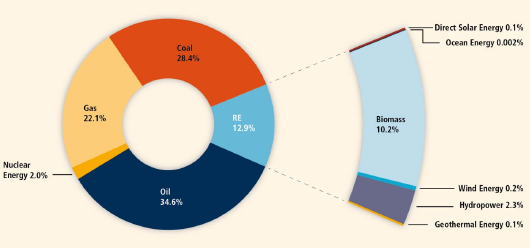
Note, without the direct equivalent accounting method used above, nuclear power, for example accounts for 12 to 13% total world electricity supply but the IPCC explains the use of direct equivalent
to also include their heating value so it is primary energy not just electricity. The IPCC noted that renewable energy contributed approximately 19% of global electricity supply. (p.5)
The vast majority of renewables is biomass, meaning burning wood, using animal dung etc but also includes commercial production of bioenergy. The IPCC noted that some 60% of biomass is used in cooking and heating applications in developing countries though there is rapid increase in using modern biomass. Compared to global primary energy, however, direct solar energy (0.1%), wind power (0.2%) and somewhat questionable hydropower (2.3%) are minuscule but use differs significantly in different parts of the world.
As the above IPCC report also notes, the costs of renewable energies are declining all the time and will continue to decline as more and more is deployed. At present, the cost can be higher than other sources of energy which puts some people off the idea that they could be a viable, large scale alternative to nuclear power.
However, fossil fuels are increasing in price while the cost of renewables continue to decline and become more and more competitive, so as the IPCC also urges, it makes economic sense to give it a political push too to help provide a significant boost as there is huge potential although there are still many challenges ahead.
Those favoring a strict neoliberal economic ideology will argue that the state should not interfere in markets, yet history shows that the market has hardly ever functioned without the state, and indeed the state has often been the major reason a market has even appeared. For democratic countries, governments subsidizing renewable and alternatives could reflect the desires of many of that nation’s constituents. If fossil fuel companies fear competition, they should (and many are) become more active in this area, but not stifle important and urgent debate and research.
Nuclear as a suitable alternative to fossil fuels?
Although nuclear disasters such as Chernobyl, or geopolitical issues such as Iran are often cause for worry when talking of using nuclear energy, recent years have seen an emergent debate about the potential that nuclear energy offers as a large scale alternative to fossil fuels in a world where energy demands are rapidly increasing.
For some, the risks associated with the technology are too high and renewable energy is far safer, and has high potential. For others, nuclear is seen as either an unfortunate reality that will be essential part of the future mix or an area that has further potential.
When one of the biggest earthquakes on record followed by a devastating tsunami affected Japan in March 2011, some of the older nuclear power reactors at Fukushima suffered what eventually was realized as a nuclear meltdown. Of the numerous issues that the disaster raised, nuclear policy became an issue in many places around the world.
Japan’s nuclear reactors that suffered from the incredibly huge earthquake were the older models. Nuclear experts point out that the newer designs are much more robust. Many are still worried however. Even if newer ones are more robust, if an even more powerful earthquake does occur then are those going to be safe?
Civil society started to debate nuclear power in Japan more. Japan had about 30% of its electricity from nuclear power and had originally planned to increase that to 50%. However, given the growing concerns in the wake of the impacts at Fukushima, in May, Japan announced a change in strategy: abandon plans for half of Japan’s electricity to come from nuclear and instead look to renewables such as solar and wind energy.
But this has also got other regions around the world thinking about their nuclear energy strategies, too. For example,
- Many countries in Europe have been rethinking nuclear policies, Inter Press Service (IPS) notes. Germany in particular (more below). France, more reliant on nuclear power than any other country, has so far felt no need to change its nuclear power policy though anti-nuclear voices are growing louder. There are concerns about the use of nuclear power in seismic zones in some EU countries such as Bulgaria, Romania, and Slovenia.
- Italy — the only leading industrialized country without nuclear energy — also suspended its previous plans to build new nuclear power plants.
- IPS also noted that the European Union’ announcement that it will be carrying out stress tests on all 143 nuclear reactors in operation in the member countries. These tests could lead to shutting down several nuclear power plants, if needed.
- Germany has been profoundly affected by Fukushima, IPS also adds.
- After the Japan catastrophe, some 60,000 people gathered in an anti-nuclear demonstration at the oldest nuclear power plant, in Berlin. Many thousands demonstrated on other days, too.
- Previous ruling parties had decided to phase out nuclear power, but Angela Merkel’s government had always stated it would overrule it if it came into power and it did so last September.
- Another IPS report notes that a large number of environmental and energy experts have said that Germany could do without nuclear power by the mid 2020s and generate all its electricity needs from renewables by 2050.
- In mid-March, Germany
stunned
the world when announcing an accelerated phasing out of all 17 German nuclear reactors as an immediate reaction to the Fukushima disaster in Japan. The chancellor now says she wants to slash the use of coal, speed up approvals for renewable energy investments, and reduce CO2 emissions drastically. - (Perhaps it is not as surprising as it first seems, as back in 2009 IPS noted that half of all Germany’s nuclear reactors had technical problems at some point in July 2009, failing to provide any electricity, but Germany did not suffer any power shortages as it produces more than it uses.)
- France gets 80% of its electricity from nuclear power, more than any other nation in the world. But in the wake of Fukushima, the French press, traditionally a supporter of nuclear power noted that in the previous year alone, there were over 1,000 accidents of different intensity in the France’s atomic power plants.. In addition, several French nuclear power plants are located in seismic zones as the previous IPS story notes. Given France’s dependency on nuclear power, it defends the use of it for now. Aging power plants are coming under more scrutiny now, however. Some experts there also believe that a combination of turning to renewals, while addressing wasteful and superfluous consumption could help reduce nuclear dependency.
- The US is also beginning to debate if it could handle a similar nuclear disaster. It is a large producer of nuclear power, and for now has put aside calls for a moratorium on nuclear power development in favor strengthening and assuring the public of the safety of its nuclear power plants.
- Philippines President Benigno Aquino has rejected the need for nuclear energy in his country in the wake of the crisis unfolding in Japan. Aquino wants a greater push towards non-nuclear energy sources, according to the Philippines media. The same article also notes that China, Thailand and Indonesia are all being more cautious in light of the events in Japan.
Others, however, are still interested in going ahead with nuclear power as many countries still see it as a way to reduce carbon emissions. Australia, as a major uranium exporter, is therefore keen to capitalize on this continued demand for nuclear power.
As IPS also added, prior to the Japanese radiation emergency, the IAEA anticipated that up to 25 countries that do not have a nuclear power station at present would have access to the technology by 2030. How many will still go for it, and to what extent is of course less clear now. Some nations still interested in the option to aggressively expand nuclear power plants (though still announcing more caution) include India, Vietnam, and a much more cautious Thailand and Indonesia.
During the initial media blitz as people at Fukushima were going through various attempts to stabilize the situation, various nuclear experts appeared on television noting that newer power plants are much more modern than the ones suffering the most in Fukushima and that in some parts of the world that are not in earthquake zones, nuclear power remains a viable option.
That being said, as The Guardian has implied, if the 3rd and 4th largest economies in the world (Japan and Germany) can rethink nuclear power to such an extent and entertain renewables at a much larger scale, then maybe so can many others.
But as by the IPCC report mentioned earlier, the transition to renewables also brings with it challenges, including technical, social, economic, political and geopolitical ones.
New resources for alternative energy; same old geopolitics?
Automakers are looking into the next generation electric or hybrid cars. The main resource for the battery would be lithium, already used in smaller electronic devices and far more efficient and longer-lasting than regular batteries.
Almost half the world’s lithium is found in Bolivia, and as The Seattle Times notes, Bolivia is reluctant to give up lithium resources too easily.
Bolivia and the US have had thorny relations as the democratically elected socialist and indigenous leader, Evo Morales, has nationalized oil and gas companies, much to the disappointment of the US, and with general support from his population as he attempts to slowly develop the extremely poor nation.
This means that the European Union and Japan have been trying to court Bolivia in the hopes they can invest in lithium extraction.
But as this PBS video highlights, geopolitics are again the concern; Bolivia fears that others will exploit it for rich resources, just as most resource-rich nations have been plundered/exploited in the past. It may be that this time the exploitation may not be as violent as during imperial and colonial times, but resource-rich/economically-poor nations like Bolivia are understandably hesitant to give up a valuable resource without local benefits.
So it seems that Bolivia is trying hard to understand the resource more and possibly develop local capacity so that it is not just a raw resource provider, but can go further and process the resources, with much if not all proceeds helping local populations:
Here is an additional video (in Spanish, with English captioning) that also looks at this issue:
Local renewable energy reduces violence yet may be a threat to governments
One of the interesting aspects to alternatives to fossil fuels is if any of those alternatives can by generated by citizens themselves or in more localized settings, rather than relying on governments or massive industry to supply such alternatives.
If that were to happen, it implies enormous political change. This is summarized quite well by the following article that looks at the implication of Cold Fusion becoming reality (ignoring the debate and controversy about Cold Fusion claims for the moment):
Suddenly, certain areas of the world that have built up economies based on oil production would become less important. These areas might suffer economically. However, it would take a period of time for the world to transition to a cold fusion based economy and these nations would have years to prepare.
The
powers that bealso might not like the idea that this technology could give individuals, communities, cities, states, and small countries energy independence. Cheap energy represents unlimited wealth and wealth brings power. The powers that be do not like sharing power. A technology that could give people the ability to liveoff the grid, start self sufficient communities, or liberate themselves from oppressive central governments might be considered a threat.This technology literally gives power to the people. How will the governments of the world respond to that?
Writing just before the mid-east unrest started to take hold of mainstream attention at the beginning of 2011, Phil Champain wrote in openDemocracy.net that centralized energy production contributes to violence and instability:
Elite capture of oil and gas revenues keeps power in the hands of an unaccountable few; the withholding of oil and gas supplies enables some states to manipulate others; and the extraction of resources is sometimes only possible if large numbers of people are forcibly moved from their homes. These and other factors can lead to violence and instability, inhibiting development and security for vulnerable communities.
… It is by no means certain … that … new, large scale renewable projects will benefit the peace and development prospects of countries already exposed to vulnerability, conflict and weak governance.
There are, by comparison, small-scale renewable energy projects, from farm biogas to mini-hydro to thermal solar power. [Solar power] is essentially limitless and so, in a concentrated form under local control with falling costs, becomes affordable, accessible, and likely to reduce pressures which give rise to violence. However, the relationship between small scale models of energy provision and the ability of states and communities to manage tension and violence also needs further research and exploration.
Now is the time to explore these links.
…
And if these alternatives are not explored?
The cost of not taking this opportunity is likely to be a continuation of systems of energy provision which privilege the northern hemisphere over the south, which deny large sections of the world’s population access to electricity and other forms of energy, which leave the populations of conflict affected countries vulnerable to authoritarian masters, unenlightened energy companies and the increasingly energy hungry states of the north, and which make little contribution to the governance challenges the world faces. This despite the key role energy plays in the development of our societies.
It was thought that the global financial crisis and climate change was a perfect storm
to kick start an earnest look into alternative energy. There has certainly be an increase in recent years into this, but now the unrest in the middle east surely adds to the importance of this issue.
More Information
Many people have recently asked me to write about this topic, and unfortunately lack of spare time has prevented me from writing about this sooner. At the same time, the above is woefully short as there is much more that can be written. However, related issues—including many issues touched upon above—have been discussed on this site for some time, so until I get some time to write about this important topic in more depth, please see the following pages and sections:
Author and Page Information
- Created:
- Last updated: